SWAMIS is a freely available open source feature tracking
suite. It was written with magnetic feature tracking in mind, but can be
applied to feature tracking of a sequence of any kind of image. It was written
by Craig DeForest
and Derek Lamb at the Southwest Research Institute
Department of Space Studies in Boulder, Colorado. The latest version
can always be downloaded at the SWAMIS website.
Tracking with SWAMIS is accomplished with five steps, each step
a separate program:
Detection in which features are
identified in each image.
Identification in which the detected features are
given unique identification numbers in each image.
Association in which the features in an image are
associated with features in the preceeding and succeeding images, and
thus given unique identification numbers throughout their lifetime.
Tabulation in which summary information is produced
for each feature in each frame. This information is total flux, size,
and center of gravity x & y coordinates.
Event Classification in which the birth and death
mechanisms for each feature are determined, as well as the feature
associated with each event.
SWAMIS has been chosen to provide magnetic feature
tracking for the Solar Dynamics
Observatory. Future versions of SWAMIS will
operate in full pipeline mode, instead of the "batch" mode that has
been provided up to and including the 2010 November 9th release.
Things You Need
The SWAMIS Guide (htmlpdf)will guide you through the steps of
installing the necessary programs and show you how to use SWAMIS.
Note: This guide was last updated in 2005, and so is likely out of date. Contact Derek Lamb (email below) if you need help getting things installed and running.
PGPLOT
is a powerful library of graphics subroutines. SWAMIS uses it for
monitoring of the tracking process, so it's not an absolute necessity, but it
might be handy to have. If you're doing any sort of scientific plotting
with SWAMIS results, you probably need this. You also need the PGPLOT Perl module, available from CPAN.
The Perl Data Language (PDL).
SWAMIS is written in PDL, a powerful, freely available scientific
programming language. It is available via SolarSoft and is beginning
to come with some Linux distributions, so it is possible that you
already have it. The PDL webpage has the most up-to-date instructions for installing PDL.
SWAMIS itself (md5). These are
the PDL programs that actually do the tracking.
Examples
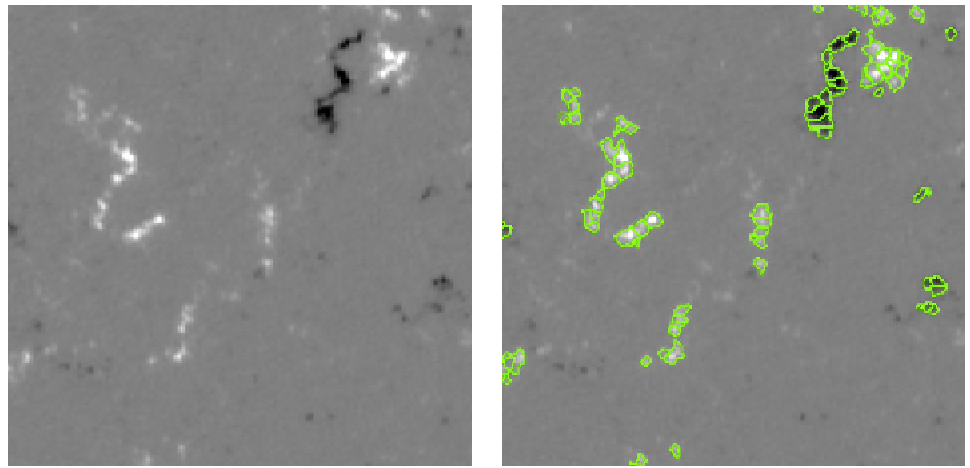
Here are some images of SWAMIS in action:
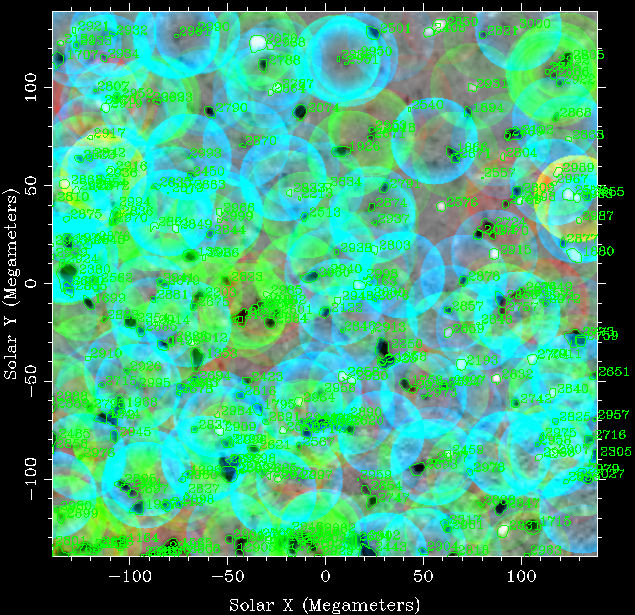
A sample frame showing the ability of SWAMIS to correctly
track features in a magnetogram sequence.
Around each feature we drew a contour of the detected feature, and
labeled it with its identification number. The green, blue, yellow, and
red circles represent different types of feature origins taking
place.
Backported some features developed for SWAMIS for
SDO. In frag_detect, features can also be found if there is a
collection of 3 or more pixels above the low threshold. Small fix to
the "downhill" discriminator. Made the swamis.pdl wrapper OS agnostic
when removing the old contents of the directories.
Posted final "batch" SWAMIS version.
frag_tabulate.pdl has been replaced with frag_tabulate_range.pdl.
There have been a few bug fixes, some usability improvements, and some
documentation added. The wrapper routine swamis.pdl now accepts
options like a normal program. Future effort
regarding SWAMIS will focus on supporting the Solar
Dynamics Observatory and will be fully pipelined.
The following is a list of publications that use SWAMIS in a main or supporting role. If we are missing any, please let us know!
Deng, N. et al., "Association of Rapid Blueshifted Events with Photospheric Magnetic Field Evolution", in preparation.
Lamb, D. A. et al., "Spatial Nonlocality of the Small-Scale Solar Dynamo", 2014 ApJ arXiv
Lamb, D. A. et al., "Solar Magnetic Tracking. IV. The Death of Magnetic Features", 2013 ApJ ADS
Huang, Z., et al., "Coronal hole boundaries at small scales. IV. SOT view. Magnetic field properties of small-scale transient brightenings in coronal holes", 2012 A&A, ADS
Lamb, D. A. et al., "Solar Magnetic Tracking. III. Apparent Unipolar Flux Emergence in High-resolution Observations", 2010 ApJ ADS
Xie, Z. X. et al., "Properties of magnetic elements in the quiet Sun using the marker-controlled watershed method", 2009 A&A ADS
Parnell, C. E., et al., "A Power-Law Distribution of Solar Magnetic Fields Over More Than Five Decades in Flux", 2009 ApJ ADS
Lamb, D. A., "Formation and evolution of small-scale solar magnetic fields", 2008 PhDT ADSLulu
Lamb, D. A. et al., "Solar Magnetic Tracking. II. The Apparent Unipolar Origin of Quiet-Sun Flux", 2008 ApJ ADS
DeForest, C. E. et al., "Solar Magnetic Tracking. I. Software Comparison and Recommended Practices", 2007 ApJ ADS