How does LAMP work?
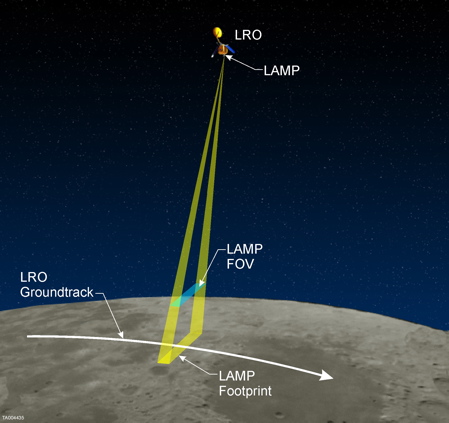
The diagram above shows how LAMP's field of view (abbreviated as FOV) tracks along the surface of the Moon. From its perch on the orbiting Lunar Reconaissance Orbiter, LAMP points straight down at the Moon's surface (at "the nadir," as scientists put it ), scanning a little bit at a time. As LRO progresses in its orbit, LAMP's map, assembled from these scans, becomes more and more complete.
The permanently shadowed regions of the Moon don't ever see sunlight or earthshine, whose reflection off the Moon is what has allowed past "cameras" aimed at the lunar surface to take pictures and make maps. But these familiar kinds of visible light aren't the only ones out there. The Moon, like all bodies in space, is constantly bathed with ultraviolet light from stars. Another source of UV light comes from clouds of hydrogen atoms drifting through our solar system, which can scatter certain wavelengths of sunlight back toward the Earth and Moon. These special wavelengths of UV light are invisible to our eyes and most of our cameras.
But the sensory equipment inside LAMP can pick up on these dim wavelengths as they reflect off the Moon's surface. As one NASA description put it, "To LAMP's sensor, space itself is literally aglow in all directions." What's more, water ice also absorbs light in the same range of the spectrum, so LAMP will also be able to gather evidence on that front. Other parts of LAMP can then transmit this data back to scientists on Earth, who in turn will use it to make maps of the surface and pinpoint likely ice deposits.
Return to the top of the page.
Atomic Emission Spectra and LAMP
LAMP is an acronym for Lyman-Alpha Mapping Project. But what does the "Lyman-Alpha" part of that refer to? Each chemical element in the universe has a characteristic "emission spectrum," that is, a set of electromagnetic waves emitted by atoms of that element when their electrons move around. "Electromagnetic waves" is a fancy term for light, which ranges from short-wavelength gamma rays to long-wavelength radio waves, with other types like ultraviolet and infrared light in between. Visible light, the only kind of light our eyes can detect, lies in a narrow range between ultraviolet and infrared. View a diagram of the spectrum.
Cameras and scopes of various kinds can detect particular spectra in a way roughly comparable to how our eyes can detect the visible spectrum, allowing us to use light that our eyes can't see to help us interpret features of the universe that might otherwise be dark to us (think of infrared glasses that allow soldiers to see in the dark!).
One part of the ultraviolet spectrum of the hydrogen atom (which is made up of a single electron orbiting around a proton) is called the Lyman series; that series itself includes light at different specific wavelengths that is emitted or absorbed as the electron of the hydrogen atom jumps from one type of orbit to another. The brightest of the Lyman series (dubbed Lyman alpha) has a wavelength of 121.6 nanometers, and it is to this wavelength that LAMP's "eyes" have been tuned. When Lyman alpha light emitted by hydrogen atoms bounces off the Moon's surface, the LAMP instrument will be able to detect and record it. In addition to Lyman-alpha waves, LAMP will also be able to detect the ultraviolet waves characteristic of starlight.
Here is a map of the Lyman-alpha emission as seen in different directions on the night sky:
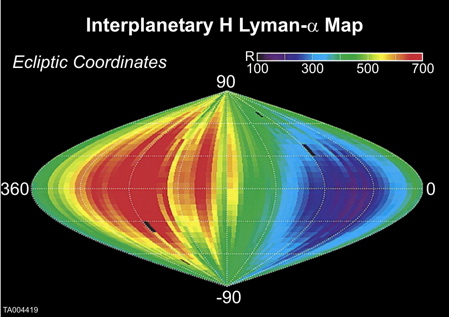
This map, obtained by the Japanese Nozomi mission, shows how hydrogen emissions change in brightness depending on where you look. They also depend on where in the solar system you’re looking from. The interplanetary hydrogen Lyman-alpha waves that LAMP can sense come from all over the sky, but are generally brighter in the “upstream” direction – the direction the clouds of hydrogen atoms are coming from as they pass through the solar system.
Return to the top of the page.
The LAMP Instrument
The LAMP instrument is what is called an "imaging spectrometer." Here's a picture of the LAMP instrument in the clean room at SwRI:
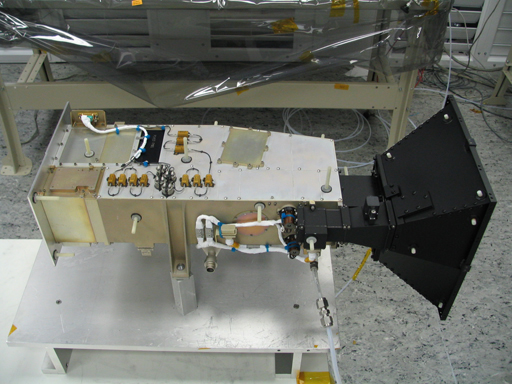
LAMP's design is not new. It is nearly identical to the New Horizons ALICE instrument, now en route to Pluto. ALICE's task is slightly different from LAMP's: it will probe the atmospheric composition of Pluto.
How do imaging spectrometers like ALICE and the LAMP instrument work? Click the image below for a larger version of the diagram.
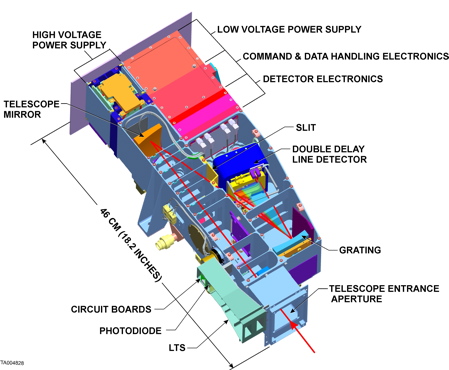
Here is an animation showing how photons pass through LAMP (one at a time) to produce a spectrum on our detector: LAMP Photon Animation
Lamp Instrument Summary
Here is a summary of some of LAMP's vital stats. Keep in mind that these are minimum requirements. LAMP now meets or exceeds these.
| Attribute | Mimimum Performance Requirement |
|---|---|
| Mass, Power | 6.1 kilograms, 4.5 watts |
| Heritage | Pluto-ALICE Ultraviolet Spectrograph |
| Passband | 57.5 - 196.5 nm (first order) |
| Effective Area | 1.3 ± 0.4cm² at 121.6 nm (Lyman-alpha) |
| Slit Field-of-View | (0.31 ° ± 0.01° ) x (6.00° ± 0.01°) |
| Spectral Resolution | 0.182 ± 0.001 nm |
| Spatial Resolution | 0.29° ± 0.03° per spatial element |
| Filled Slit Spectral Resolution | 3.64 ± 0.18nm FWHM |
| Stray Light | < 8x10⁻⁶ at 7° off boresight |
| Average Nightside Countrate | 400 Hz |
| Dark Count Rate | <20 counts/second |
| Detector Output | Continuous pixel list |