 Pluto, the Ninth Planet Pluto, the Ninth Planet
Ever since the early 1980's, I've been fascinated by Pluto and have been working to learn more about this little world. Every line of study is fair game and I've worked long and hard from many directions to add to our collective knowledge. The items listed below will take you to areas that I've worked on or perhaps point you to interesting information that others have come up with. If you don't see something here that you want to see explained, send me e-mail and I'll add it to the list of questions answered on these web pages.
 2010 Feb 4: After years of
work I have completed reconstructing maps of the surface of Pluto from
images taken with the Hubble Space Telescope. Check out the official
press release from the
Space Telescope Science Institute and
NASA.
I also have more information about these maps, how I made them, and other
cool stuff. Also, see what Pluto looks like right now: a wide field showing all the moons, a medium field with just Pluto and Charon, or a
closeup of just Pluto. These images are
a combination of art and my new maps. I've added some texture to the
surface to make it more interesting. But, the overall light and dark
patterns and the general color are taken from the HST maps.
If you want the full scientific story check out the two papers released
on Feb. 4, 2010 (Clyde Tombaugh's 104th birthday, totally by chance):
Paper I
and
paper II.
2010 Feb 4: After years of
work I have completed reconstructing maps of the surface of Pluto from
images taken with the Hubble Space Telescope. Check out the official
press release from the
Space Telescope Science Institute and
NASA.
I also have more information about these maps, how I made them, and other
cool stuff. Also, see what Pluto looks like right now: a wide field showing all the moons, a medium field with just Pluto and Charon, or a
closeup of just Pluto. These images are
a combination of art and my new maps. I've added some texture to the
surface to make it more interesting. But, the overall light and dark
patterns and the general color are taken from the HST maps.
If you want the full scientific story check out the two papers released
on Feb. 4, 2010 (Clyde Tombaugh's 104th birthday, totally by chance):
Paper I
and
paper II.
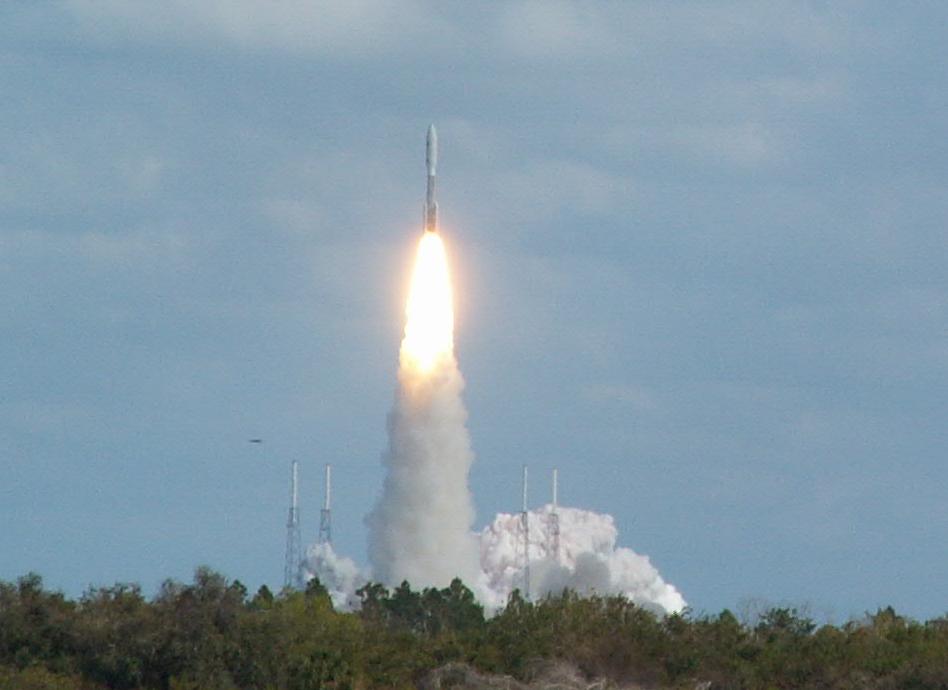
We're going to Pluto! New Horizons was successfully launched on January 19, 2006 at 2:00pm EST. I was there to see it and it was a glorious sight. We passed Jupiter in February 2007, Saturn in June 2008, and get to Pluto on July 14, 2015. Check out this page to see where the spacecraft is now (courtesy of Daniel Muller).
Here's a copy (3.5Mb) of my public lecture at the Kennedy Space Center on January 17, 2006 that I gave just before launch.