Selected Publications
by Joel Wm. Parker
Selected Publications
by Joel Wm. Parker

 ``Ultraviolet Discoveries at Asteroid (21) Lutetia by the Rosetta Alice
Ultraviolet Spectrograph''
Stern, S. A., J.Wm. Parker, P. D. Feldman, H. A. Weaver, A. Steffl, M. F.
A'Hearn, L. Feaga, E. Birath, A. Graps, J.-L. Bertaux, D. C. Slater, N.
Cunningham, M. Versteeg, & J. R. Scherrer
2011, The Astronomical Journal, 141, 199
``Ultraviolet Discoveries at Asteroid (21) Lutetia by the Rosetta Alice
Ultraviolet Spectrograph''
Stern, S. A., J.Wm. Parker, P. D. Feldman, H. A. Weaver, A. Steffl, M. F.
A'Hearn, L. Feaga, E. Birath, A. Graps, J.-L. Bertaux, D. C. Slater, N.
Cunningham, M. Versteeg, & J. R. Scherrer
2011, The Astronomical Journal, 141, 199
``A Search for Satellites around Ceres''
Bieryla, A., J.Wm. Parker, E. F. Young, L. A. McFadden, C. T. Russell, S.
A. Stern, M. V. Sykes, & B. Gladman
2011, The Astronomical Journal, 141, 197
``LRO-LAMP Observations of the LCROSS Impact Plume''
Gladstone, G. R., D. M. Hurley, K. D. Retherford, P. D. Feldman, W. R.
Pryor, J.-Y. Chaufray, M. Versteeg, T. K. Greathouse, A. J. Steffl, H.
Throop, J.Wm. Parker, D. E. Kaufmann, A. F. Egan, M. W. Davis, D. C.
Slater, J. Mukherjee, P. F. Miles, A. R. Hendrix, A. Colaprete, & S. A.
Stern
2010, Science, 330, 472
``On the Detection of Two New Trans-Neptunian Binaries from the CFEPS
Kuiper Belt Survey''
Lin, H.-W., J. J. Kavelaars, W.-H. Ip, B. J. Gladman, J. M. Petit, R. L.
Jones, & J.Wm. Parker
2010, Publications of the Astronomical Society of the Pacific, 122, 1030
``The far-ultraviolet albedo of Šteins measured with Rosetta-ALICE''
A'Hearn, M. F., L. M. Feaga, J.-L. Bertaux, P. D. Feldman, J.Wm. Parker, D.
C. Slater, A. J. Steffl, S. Alan Stern, H. Throop, M. Versteeg, H. A.
Weaver, & H. Uwe Keller
2010, Planetary and Space Science, 58, 1088
``New Horizons Alice ultraviolet observations of a stellar occultation by
Jupiter's atmosphere''
Greathouse, T. K., G. R. Gladstone, J. I. Moses, S. A. Stern, K. D.
Retherford, R. J. Vervack, D. C. Slater, M. H. Versteeg, M. W. Davis, L. A.
Young, A. J. Steffl, H. Throop, & J.Wm. Parker
2010, Icarus, 208, 293
``Photometric mapping of Asteroid (4) Vesta's southern hemisphere with
Hubble Space Telescope''
Li, J.-Y., L. A. McFadden, P. C. Thomas, M. J. Mutchler, J.Wm. Parker, E.
F. Young, C. T. Russell, M. V. Sykes, & B. E. Schmidt
2010, Icarus, 208, 238
``Ultraviolet and visible photometry of asteroid (21) Lutetia using the
Hubble Space Telescope''
Weaver, H. A., P. D. Feldman, W. J. Merline, M. J. Mutchler, M. F. A'Hearn,
J.-. L. Bertaux, L. M. Feaga, J.Wm. Parker, D. C. Slater, A. J. Steffl, C.
R. Chapman, J. D. Drummond, & S. A. Stern
2010, Astronomy and Astrophysics, 518, A4
``Systematic Biases in the Observed Distribution of Kuiper Belt Object
Orbits''
Jones, R. L., J.Wm. Parker, A. Bieryla, B. G. Marsden, B. Gladman, J.
Kavelaars, & J.-M. Petit
2010, The Astronomical Journal, 139, 2249
``LAMP: The Lyman Alpha Mapping Project on NASA's Lunar Reconnaissance
Orbiter Mission''
Gladstone, G. R., S. A. Stern, K. D. Retherford, R. K. Black, D. C. Slater,
M. W. Davis, M. H. Versteeg, K. B. Persson, J.Wm. Parker, D. E. Kaufmann,
A. F. Egan, T. K. Greathouse, P. D. Feldman, D. Hurley, W. R. Pryor, & A.
R. Hendrix
2010, Space Science Reviews, 150, 161
``The Shape and Surface Variation of 2 Pallas from the Hubble Space
Telescope''
Schmidt, B. E., P. C. Thomas, J. M. Bauer, J.-Y. Li, L. A. McFadden, M. J.
Mutchler, S. C. Radcliffe, A. S. Rivkin, C. T. Russell, J.Wm. Parker, & S.
A. Stern
2009, Science, 326, 275
``Discovery of the First Retrograde Transneptunian Object''
Gladman, B., J. Kavelaars, J.-M. Petit, M. L. N. Ashby, J. Parker, J.
Coffey, R. L. Jones, P. Rousselot, & O. Mousis
2009, The Astrophysical Journal, 697, L91
``The Canada-France Ecliptic Plane Survey—L3 Data Release: The Orbital
Structure of the Kuiper Belt''
Kavelaars, J. J., R. L. Jones, B. J. Gladman, J.-M. Petit, J.Wm. Parker, C.
Van Laerhoven, P. Nicholson, P. Rousselot, H. Scholl, O. Mousis, B.
Marsden, P. Benavidez, A. Bieryla, A. Campo Bagatin, A. Doressoundiram, J.
L. Margot, I. Murray, & C. Veillet
2009, The Astronomical Journal, 137, 4917
``ALICE: The Ultraviolet Imaging Spectrograph Aboard the New Horizons
Pluto-Kuiper Belt Mission''
Stern, S. A., D. C. Slater, J. Scherrer, J. Stone, G. Dirks, M. Versteeg,
M. Davis, G. R. Gladstone, J.Wm. Parker, L. A. Young, & O. H. W. Siegmund
2008, Space Science Reviews, 140, 155
``The Extreme Kuiper Belt Binary 2001 QW322''
Petit, J.-M., J. J. Kavelaars, B. J. Gladman, J. L. Margot, P. D.
Nicholson, R. L. Jones, J.Wm. Parker, M. L. N. Ashby, A. Campo Bagatin, P.
Benavidez, J. Coffey, P. Rousselot, O. Mousis, & P. A. Taylor
2008, Science, 322, 432
``The Orbital and Spatial Distribution of the Kuiper Belt''
Kavelaars, J., L. Jones, B. Gladman, J.Wm. Parker, & J.-M. Petit
2008, The Solar System Beyond Neptune, 59
``Io's Atmospheric Response to Eclipse: UV Aurorae Observations''
Retherford, K. D., J. R. Spencer, S. A. Stern, J. Saur, D. F. Strobel, A.
J. Steffl, G. R. Gladstone, H. A. Weaver, A. F. Cheng, J.Wm. Parker, D. C.
Slater, M. H. Versteeg, M. W. Davis, F. Bagenal, H. B. Throop, R. M. C.
Lopes, D. C. Reuter, A. Lunsford, S. J. Conard, L. A. Young, & J. M. Moore
2007, Science, 318, 237
``Jupiter's Nightside Airglow and Aurora''
Gladstone, G. R., S. A. Stern, D. C. Slater, M. Versteeg, M. W. Davis, K.
D. Retherford, L. A. Young, A. J. Steffl, H. Throop, J.Wm. Parker, H. A.
Weaver, A. F. Cheng, G. S. Orton, J. T. Clarke, & J. D. Nichols
2007, Science, 318, 229
``Discovering the True KBO Orbit Distribution''
JJ Kavelaars, L. Jones, B. Gladman, J.Wm. Parker,
& J.-M. Petit,
2007, in Kuiper Belt (M.A.
Barucci, H. Boehnhardt,D. Cruikshank, and A. Morbidelli, eds.; U.
Arizona Press, Tucson), in press
``Pluto, Charon, and the Kuiper Belt Objects''
S.A. Stern,J.Wm. Parker, & C.B. Olkin
2007, in Treatise on Geophysics, Volume 10: Planets and Moons
(T. Spohn, ed.; Elsivier), in press
``Ultraviolet Spectroscopy of Comet 9P/Tempel 1 with Alice/Rosetta
during the Deep Impact Encounter''
P.D. Feldman, S.A. Stern, A.J. Steffl, J.Wm. Parker, D.C. Slater,
A'Hearn, J.-L. Bertaux, & M.C. Festou
2007, Icarus, 187, 104
``Alice: The Rosetta Ultraviolet Imaging Spectrograph''
S.A. Stern, D.C. Slater, J. Scherrer, J. Stone, M. Versteeg, M.F.
A'Hearn, J.-L. Bertaux, P.D. Feldman, M.C. Festou, J.Wm. Parker, & O.H.W.
Siegmund
2007, Space Science Reviews, 128, 507
``The CFEPS Kuiper Belt Survey: Strategy and Pre-survey Results''
R.L. Jones, B. Gladman, J.-M. Petit, P. Rousselot, O. Moussis, JJ
Kavelaars, A. Campo Bagatin, G. Bernabeu, P. Benavenidez, J.Wm. Parker, P.
Nicholson, M. Holman, A. Doressoundiram, C. Veillet, H. Scholl, & G. Mars,
2006, Icarus, 185, 508
 ``Ceres: High-Resolution Imaging with HST and the Determination of Physical
Properties'',
J.Wm. Parker, L.A. McFadden, C.T. Russell, S.A. Stern,
M.V. Sykes, P.C. Thomas, & E.F. Young
2006, Advances in Space Research, 38, 2039
``Ceres: High-Resolution Imaging with HST and the Determination of Physical
Properties'',
J.Wm. Parker, L.A. McFadden, C.T. Russell, S.A. Stern,
M.V. Sykes, P.C. Thomas, & E.F. Young
2006, Advances in Space Research, 38, 2039
``Discovery of a Low-Eccentricity, High-Inclination Kuiper Belt
Object at 58 AU''
R.L. Allen, B. Gladman, JJ Kavelaars, J.-M. Petit, J.Wm. Parker, & P. Nicholson
2006, The Astrophysical Journal Letters, 684, 83L
``Differentiation of the Asteroid Ceres as Revealed by its Shape''
P.C. Thomas, J.Wm. Parker, L.A. McFadden,
C.T. Russell, S.A. Stern, M.V. Sykes & E.F. Young
2005, Nature, 437, 224
``Massive Field Stars and the Stellar Clustering Law'',
M.S. Oey, N.L. King, & J.Wm. Parker
2004, The Astronomical Journal, 127, 1632
``The Discovery of a Twelfth Wolf-Rayet Star in the Small Magellanic
Cloud'',
P. Massey, K.A.G. Olsen, & J.Wm. Parker
2003, Publications of the Astronomical Society of the Pacific,
115, 1265
``HST/STIS Observations of Comet 19P/Borrelly During the Deep Space 1
Encounter'',
H. A. Weaver, S. A. Stern, & J. Wm. Parker
2003, The Astronomical Journal, 126, 444
``Probing the Solar System's Outermost Frontier: The Future of
Kuiper Belt Studies''
(Solar System Decadal Survey community papel white paper)
W.M. Grundy, H.A. Levison, J.Wm. Parker,
R.L. Allen, L.C. Ball, J.F. Cooper,
M.C. De Sanctis, T.L. Farnham, B. Gladman,
J.M. Hahn, C.W. Hergenrother, JJ Kavelaars,
H. Kruger, D.J. Lien, R. Malhotra,
R.M.E. Mastrapa, A. Quillen, R. Srama,
J.A. Stansberry, G. Strazzulla, R.J. Terrile, &
C.A. Trujillo,
2002, in The Future of Solar System Exploration
(ed. M.V. Sykes), Astronomical Society of the Pacific Conference
Series, 272, 337
``A New Spectral Classification System for the Earliest O Stars:
Definition of Type O2'',
N. R. Walborn, I. D. Howarth, D. J. Lennon, P. Massey, M. S. Oey, A. F. J.
Moffat, G. Skalkowski, N. I. Morrell, L. Drissen, & J. Wm.
Parker,
2002, The Astronomical Journal, 123, 2754
``Magellanic Orphans:
Massive Stars Ex Nihilo?'', J. Wm. Parker 2002, in
Hot Star Workshop III: The Earliest Phases of Massive Star Birth,
Astronomical Society of the Pacific Conference Series (ed. P.A. Crowther),
267, 401
``The Binary Kuiper Belt Object 1998 WW31'',
C. Veillet, J. Wm. Parker, I. Griffin, B. Marsden, A.
Doressoundiram, M. Buie, D. J. Tholen, M. Connelley, & M. J. Holman,
2002, Nature, 416, 711 (2002 April 18)
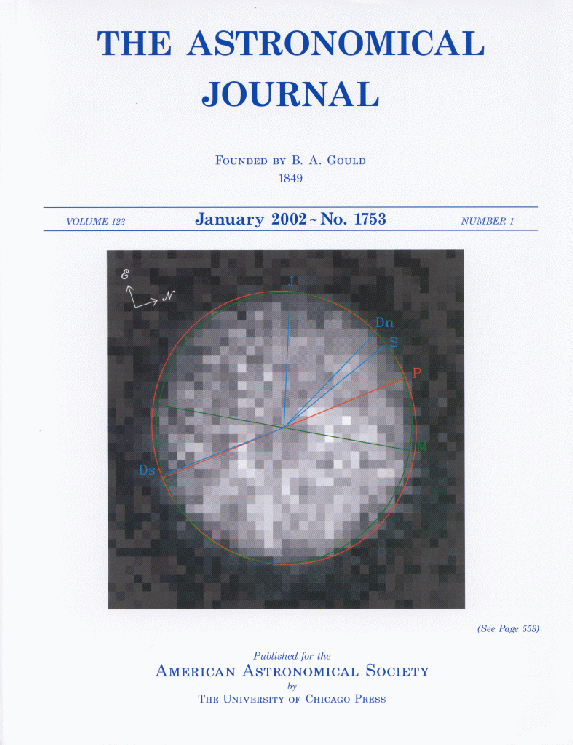
``Analysis of the First Disk-Resolved Images of Ceres from Ultraviolet
Observations with the Hubble Space Telescope'',
J. Wm. Parker, S. A. Stern, P. C. Thomas, M. C. Festou,
W. J. Merline, E. F. Young, R. P. Binzel, & L. A. Lebofsky
2002, The Astronomical Journal, 123, 549
``Ultraviolet and Optical Observations of OB Associations and Field Stars
in the Southwest Region of the Large Magellanic Cloud'', J. Wm.
Parker, D. Zaritsky, T. P. Stecher, J. Harris, & P. Massey 2001,
The Astronomical Journal, 121, 891
``The Discovery of Argon in Comet Hale-Bopp'',
S. A. Stern, D. C. Slater, M. C. Festou, J. Wm. Parker, G.
R. Gladstone, M. F. A'Hearn, & E. Wilkinson
2000, The Astrophysical Journal Letters,
544, L169
``Chiron'', J. Wm. Parker 2000, Encyclopedia of
Astronomy and Astrophysics
``A New Observational Search for Vulcanoids in SOHO/LASCO Coronagraphic Images'',
D. D. Durda, S. A. Stern, W. B. Colwell, J. Wm. Parker, H. F.
Levison, & D. M. Hassler
2000, Icarus, 148, 312
``The Ultraviolet and Optical Spectra of Metal-Deficient O Stars in the Small
Magellanic Cloud'',
N. R. Walborn, D. J. Lennon, S. R. Heap, D. J. Lindler, L. J. Smith, C. J.
Evans, & J. Wm. Parker,
2000, Publications of the Astronomical Society of the Pacific,
112, 1243
``HST/FOS Spatially Resolved Spectral Classification of Compact OB Groups in
the Large Magellanic Cloud'',
N. R. Walborn, L. Drissen, J. Wm. Parker, A. Saha, J. W.
MacKenty, & R. L. White
1999, The Astronomical Journal, 118, 1684
``Comet Hale-bopp (C/1995 O1) Near 2.3 AU Postperihelion: Southwest
Ultraviolet Imaging System Measurements of the H2O and Dust
Production''
S. A. Stern, W. B. Colwell, M. C. Festou, P. M. Tamblyn, J. Wm.
Parker, D. C. Slater, P. R. Weissman, & L. J. Paxton 1999, The
Astronomical Journal, 118, 1120
``The Spectroscopic Detectability of Argon in the Lunar Atmosphere''
J. Wm. Parker, S. A. Stern, G. R. Gladstone, & J. M.
Shull 1998, The Astrophysical Journal (Letters), 509, L61
``Ultraviolet Observations of Stars in The Magellanic Clouds: A Historical
Bridge From The Sun to R 136 and Beyond'', J. Wm. Parker
1998, in Hot Stars in Open Clusters of the Galaxy and the Magellanic
Clouds, RMxAA Conf. Series (ed. V. Niemela & N. Morrell),
in press
``Ultraviolet Imaging Telescope Observations of the Magellanic Clouds'',
J. Wm. Parker, J. K. Hill, R. H. Cornett, J. E. Hollis, E.
Zamkoff, R. C. Bohlin, R. W. O'Connell, S. G. Neff, M. S. Roberts, A. M.
Smith, & T. P. Stecher
1998, The Astronomical Journal, 116, 180.
``HST Mid-Ultraviolet Spectroscopy of 46P/Wirtanen During Its Approach to
Perihelion in 1996-1997'', S. A. Stern, , J. Wm. Parker,
M. C. Festou, M. F. A'Hearn, P. D. Feldman, G. Schwehm, R. Schulz, J.-L.
Bertaux, & D. C. Slater
1998, Astronomy & Astrophysics, 335, L30
``The Spectral Variability of the Cool Hypergiant Rho Cassiopeiae'',
A. Lobel, G. Israelian, C. de Jager, F. Musaev, J. Wm. Parker, & A. Mavrogiorgou
1998, Astronomy & Astrophysics, 330, 659
``Ultraviolet Spectral Morphology of the Stellar Core of Eta Carinae''
D. C. Ebbets, N. R. Walborn, & J. Wm. Parker,
1997, The Astrophysical Journal, 489, L161
``An HST Search for Magnesium in the Lunar Atmosphere'',
S. A. Stern, J. Wm. Parker, T. H. Morgan, B. C. Flynn, D. M.
Hunten, A. Sprague, M. Mendillo, & M. C. Festou
1997, Icarus, 127, 523
``The Ultraviolet Imaging Telescope:
Instrument and Data Characteristics'', T. Stecher, R. H. Cornett, M. R.
Greason, W. B. Landsman, J. K. Hill, R. S. Hill, R. C. Bohlin, P. C. Chen, N.
R. Collins, M. N. Fanelli, J. I. Hollis, S. G. Neff, R. W. O'connell, J. D.
Offenberg, R. A. Parise, J. Wm. Parker, M. S. Roberts, A. M.
Smith, & W. H. Waller 1997, Publications of the Astronomical Society of
The Pacific, 109, 584
``Ultraviolet Observations of Chiron with the HST/FOS: Examining a Centaur's
Gray Matter'',
J. Wm. Parker, S. A. Stern, M. C. Festou, M. F. A'Hearn,
& D. Weintraub
1997, The Astronomical Journal, 113, 1899
``UIT Ultraviolet Observations of the Small Magellanic Cloud'',
R. H. Cornett, M. R. Greason, J. K. Hill, J. Wm. Parker, W.
H. Waller, R. C. Bohlin, S. G. Neff, R. W. O'Connell, M. S. Roberts, A. M.
Smith, & T. P. Stecher
1997, The Astronomical Journal 113, 1011
``Ultraviolet Imaging Telescope Observations of the OB Stars in the N 11
Region of the LMC'',
J. Wm. Parker, J. K. Hill, R. C. Bohlin, R. W. O'Connell, S.
G. Neff, M. S. Roberts, A. M. Smith, & T. P. Stecher
1996, The Astrophysical Journal, 472, L29
``The variable Mass-loss of the Peculiar Supergiant P Cygni'',
G. Israelian, M. de Groot, J. Wm. Parker, & C. Sterken
1996, Monthly Notices of the Royal Astronomical Society, 283, 119
``The Stellar Initial Mass Function in the Giant H II Region NGC 595''
E. M. Malumuth, W. Waller, & J. Wm. Parker
1995, The Astronomical Journal, 111, 1128
``Identification of Emission-Line Stars in 30 Doradus using HST
Observations'',
J. Wm. Parker, S. R. Heap, & E. M. Malumuth
1995, The Astrophysical Journal, 448, 705
``International Ultraviolet Explorer Atlas of B-Type Spectra From 1200 to 1900
Å'',
N. R. Walborn, J. Wm. Parker, & J. S. Nichols
1995, NASA Reference Publication 1363
``Resolution of Massive Compact Clusters in the 30 Doradus Periphery With
HST'',
N. R. Walborn, J. W. MacKenty, A. Saha, R. L. White, & J. Wm.
Parker
1995, The Astrophysical Journal, 439, L47
``The OB Association LH 58 in the LMC'',
C. D. Garmany, P. Massey, & J. Wm. Parker
1994, The Astronomical Journal, 108, 1256
``Dynamical and Observational Constraints on Satellites in the Inner
Pluto-Charon System'',
S. A. Stern, J. Wm. Parker, M. J. Duncan, J. C. Snowdall,
Jr., & H. F. Levison
1994, Icarus, 108, 234
``The OB Associations of 30 Doradus in the Large Magellanic Cloud. I. Stellar
Observations and Data Reductions'',
J. Wm. Parker
1993, The Astronomical Journal, 106, 560
``The OB Associations of 30 Doradus in the Large Magellanic Cloud. II. Stellar
Content and Initial Mass Function'',
J. Wm. Parker & C. D. Garmany
1993, The Astronomical Journal, 106, 1471
``A New Luminous Blue Variable: R 143 in 30 Doradus'',
J. Wm. Parker, G. C. Clayton, C. Winge, & P. S. Conti
1993, Astrophysical Journal, 409, 770
``SN 1991bg: A Type Ia Supernova with a Difference'',
B. Leibundgut, R. P. Kirshner, M. M. Phillips, L. A. Wells, N. B. Suntzeff, M.
Hamuy, R. A. Schommer, A. R. Walker, L. Gonzalez, P. Ugarte, R. E. Williams,
G. Williger, M. Gomez, R. Marzke, B. P. Schmidt, B. Whitney, N. Caldwell, J.
Peters, F. H. Chaffee, C. B. Foltz, D. Rehner, L. Siciliano, T. G. Barnes, K.
-P. Cheng, P. M. N. Hintzen, Y.-C. Kim, J. Maza, J. Wm.
Parker, A. C. Porter, P. C. Schmidtke, & G. Sonneborn
1993, The Astronomical Journal, 105, 301
``Two-Stage Starbursts in The LMC: N 11 as a Once and Future 30 Doradus'',
N. R. Walborn & J. Wm. Parker
1992, Astrophysical Journal, 399, L87
``Ultraviolet and Optical Spectral Morphology of Melnick 42 and Radcliffe 136a
in 30 Doradus'',
N. R. Walborn, D. C. Ebbets, J. Wm. Parker, J.
Nichols-Bohlin, & R. L. White
1992, Astrophysical Journal, 393, L13
``30 Doradus in the Large Magellanic Cloud: The Stellar Content and Initial
Mass Function'',
J. Wm. Parker
1992, Ph.D. thesis, University of Colorado
``The Stellar Content of LH 9 and 10 in the LMC: A Case for Sequential Star
Formation'',
J. Wm. Parker, C. D. Garmany, P. Massey, & N. R. Walborn
1992, The Astronomical Journal, 103, 1205
``A Search for Distant Satellites of Pluto'',
S. A. Stern, R. A. Fesen, E. S. Barker, J. Wm. Parker, L. M.
Trafton
1991, Icarus, 94, 246
``Measuring the Direct Sky Brightness on CCD Images'',
J. Wm. Parker
1991, Publications of the Astronomical Society of the Pacific, 103, 243
``The Stellar Content of NGC 346: A Plethora of O Stars in the SMC'',
P. Massey, J. Wm. Parker, C. D. Garmany
1989, The Astronomical Journal, 98, 1305

Ultraviolet Discoveries at Asteroid (21) Lutetia by the Rosetta Alice
Ultraviolet Spectrograph
Authors:
Stern, S. A., J.Wm. Parker, P. D. Feldman, H. A. Weaver, A. Steffl, M. F.
A'Hearn, L. Feaga, E. Birath, A. Graps, J.-L. Bertaux, D. C. Slater, N.
Cunningham, M. Versteeg, & J. R. Scherrer
Status: 2011, The Astronomical Journal, 141, 199
Abstract
The NASA Alice ultraviolet (UV) imaging spectrograph on board the ESA
Rosetta comet orbiter successfully conducted a series of flyby
observations of the large asteroid (21) Lutetia in the days surrounding
Rosetta's closest approach on 2010 July 10. Observations included a
search for emission lines from gas, and spectral observations of the
Lutetia's surface reflectance. No emissions from gas around Lutetia were
observed. Regarding the surface reflectance, we found that Lutetia has a
distinctly different albedo and slope than both the asteroid (2867)
Steins and Earth's moon, the two most analogous objects studied in the
far ultraviolet (FUV). Further, Lutetia's ~10% geometric albedo near
1800 Å is significantly lower than its 16%-19% albedo near 5500
Å. Moreover, the FUV albedo shows a precipitous drop (to ~4%)
between 1800 Å and 1600 Å, representing the strongest
spectral absorption feature observed in Lutetia's spectrum at any
observed wavelength. Our surface reflectance fits are not unique but are
consistent with a surface dominated by an EH5 chondrite, combined with
multiple other possible surface constituents, including anorthite, water
frost, and SO2 frost or a similar mid-UV absorber. The water
frost identification is consistent with some data sets but inconsistent
with others. The anorthite (feldspar) identification suggests that
Lutetia is a differentiated body.
Preprint:
Contact me [Joel Parker: joel@boulder.swri.edu] for (p)reprints.
Electronic Journal Article:
Available.
ADS Links:
Available.
A Search for Satellites around Ceres
Authors:
Bieryla, A., J.Wm. Parker, E. F. Young, L. A. McFadden, C. T. Russell, S.
A. Stern, M. V. Sykes, & B. Gladman
Status: 2011, The Astronomical Journal, 141, 197
Abstract
We conducted a satellite search around the dwarf planet 1 Ceres using
Hubble Space Telescope and ground-based Palomar data. No candidate
objects were found orbiting Ceres in its entire stability region down to
~500 km from the surface of Ceres. Assuming a satellite would have the
same albedo as Ceres, which has a visual geometric albedo of 0.07-0.10,
our detection limit is sensitive to satellites larger than 1-2 km in
diameter.
Preprint:
Contact me [Joel Parker: joel@boulder.swri.edu] for (p)reprints.
Electronic Journal Article:
Available.
ADS Links:
Available.
LRO-LAMP Observations of the LCROSS Impact Plume
Authors:
Gladstone, G. R., D. M. Hurley, K. D. Retherford, P. D. Feldman, W. R.
Pryor, J.-Y. Chaufray, M. Versteeg, T. K. Greathouse, A. J. Steffl, H.
Throop, J.Wm. Parker, D. E. Kaufmann, A. F. Egan, M. W. Davis, D. C.
Slater, J. Mukherjee, P. F. Miles, A. R. Hendrix, A. Colaprete, & S. A.
Stern
Status: 2010, Science, 330, 472
Abstract
On 9 October 2009, the Lunar Crater Observation and Sensing Satellite
(LCROSS) sent a kinetic impactor to strike Cabeus crater, on a mission
to search for water ice and other volatiles expected to be trapped in
lunar polar soils. The Lyman Alpha Mapping Project (LAMP) ultraviolet
spectrograph onboard the Lunar Reconnaissance Orbiter (LRO) observed the
plume generated by the LCROSS impact as far-ultraviolet emissions from
the fluorescence of sunlight by molecular hydrogen and carbon monoxide,
plus resonantly scattered sunlight from atomic mercury, with
contributions from calcium and magnesium. The observed light curve is
well simulated by the expansion of a vapor cloud at a temperature of
~1000 kelvin, containing ~570 kilograms (kg) of carbon monoxide, ~140 kg
of molecular hydrogen, ~160 kg of calcium, ~120 kg of mercury, and ~40
kg of magnesium.
Preprint:
Contact me [Joel Parker: joel@boulder.swri.edu] for (p)reprints.
Electronic Journal Article:
Available.
ADS Links:
Available.
On the Detection of Two New Trans-Neptunian Binaries from the CFEPS Kuiper
Belt Survey
Authors:
Lin, H.-W., J. J. Kavelaars, W.-H. Ip, B. J. Gladman, J. M. Petit, R. L.
Jones, & J.Wm. Parker
Status: 2010, Publications of the Astronomical Society of the Pacific,
122, 1030
Abstract
<?A3B2 twb .4w?>We report here the discovery of new
near-equal-mass trans-Neptunian Binary (TNB) L5c02 and the the putative
detection of a second TNB (L4k12) among the detections in the second and
third years of the Canada-France Ecliptic Plane Survey (CFEPS). These
new binaries (internal designations L4k12 and L5c02) have moderate
separations of 0.4″ and 0.6″, respectively. The follow-up
observation confirmed the binarity of L5c02, but L4k12 still lacks
follow-up observations. L4k12 has a heliocentric orbital inclination of
˜35°, marking this system as having the highest heliocentric
orbital inclination among known near-equal-mass binaries. Both systems
are members of the classical main Kuiper belt population. Based on the
sample of objects searched, we determine that the fraction of
near-equal-mass wide binaries with separations >0.4 is 1.5% to 20% in
the cold main classical Kuiper belt, and if our detection of the
binarity L4k12 holds, 3% to 43% in the hot main classical objects are
binary. In this article we describe our detection process, the sample of
objects surveyed, and our confirmation observations.
Preprint:
Contact me [Joel Parker: joel@boulder.swri.edu] for (p)reprints.
Electronic Journal Article:
Available.
ADS Links:
Available.
The far-ultraviolet albedo of Šteins measured with Rosetta-ALICE
Authors:
A'Hearn, M. F., L. M. Feaga, J.-L. Bertaux, P. D. Feldman, J.Wm. Parker, D.
C. Slater, A. J. Steffl, S. Alan Stern, H. Throop, M. Versteeg, H. A.
Weaver, & H. Uwe Keller
Status: 2010, Planetary and Space Science, 58, 1088
Abstract
During Rosetta's flyby of the asteroid (2867) Šteins in
2008, we used the ALICE instrument to measure the first far-ultraviolet
(FUV) reflectivity spectrum of an asteroid (850-2000 Å). It is
very dark in the FUV, ˜4%, compared to its very high reflectivity
(40%) at optical wavelengths. The FUV albedo does not exhibit a
systematic color trend across the spectral range, but there is a broad
absorption feature, not yet identified with a specific mineral, with
maximum depth near 1650 Å. The shape of this feature implies a
very low abundance of Fe2+ ions in the surface minerals. The
FUV brightness exhibits a significant opposition surge at phases below
10°. The visible/FUV color gets much redder with increasing phase
angle inside the opposition surge and gets gradually redder at larger
phase angles. We also conducted a deep search for an exosphere of atoms
sputtered from the surface and set upper limits on any column densities
of oxygen and hydrogen atoms at the time of our observations. The upper
limit for H is comparable to that predicted by the only theoretical
prediction of which we are aware, while that for O is higher than
predicted by about an order of magnitude.
Preprint:
Contact me [Joel Parker: joel@boulder.swri.edu] for (p)reprints.
Electronic Journal Article:
Available.
ADS Links:
Available.
New Horizons Alice ultraviolet observations of a stellar occultation by
Jupiter's atmosphere
Authors:
Greathouse, T. K., G. R. Gladstone, J. I. Moses, S. A. Stern, K. D.
Retherford, R. J. Vervack, D. C. Slater, M. H. Versteeg, M. W. Davis, L. A.
Young, A. J. Steffl, H. Throop, & J.Wm. Parker
Status: 2010, Icarus, 208, 293
Abstract
The Alice ultraviolet spectrograph onboard the New Horizons spacecraft
observed two occultations of the bright star χ Ophiucus by
Jupiter's atmosphere on February 22 and 23, 2007 during the
approach phase of the Jupiter flyby. The ingress occultation probed the
atmosphere at 32°N latitude near the dawn terminator, while egress
probed 18°N latitude near the dusk terminator. A detailed analysis
of both the ingress and egress occultations, including the effects of
molecular hydrogen, methane, acetylene, ethylene, and ethane absorptions
in the far ultraviolet (FUV), constrains the eddy diffusion coefficient
at the homopause level to be 3.4-2.8+9.0×10⁶
cm2 s−1, consistent with Voyager
measurements and other analyses (Festou, M.C., Atreya, S.K., Donahue,
T.M., Sandel, B.R., Shemansky, D.E., Broadfoot, A.L. [1981]. J. Geophys.
Res. 86, 5717-5725; Vervack Jr., R.J., Sandel, B.R., Gladstone,
G.R., McConnell, J.C., Parkinson, C.D. [1995]. Icarus 114,
163-173; Yelle, R.V., Young, L.A., Vervack Jr., R.J., Young, R.,
Pfister, L., Sandel, B.R. [1996]. J. Geophys. Res. 101 (E1),
2149-2162). However, the actual derived pressure level of the
methane homopause for both occultations differs from that derived by
Festou et al. (1981) and Yelle et al. (1996) from the Voyager
ultraviolet occultations, suggesting possible changes in the strength of
atmospheric mixing with time. We find that at 32°N latitude, the
methane concentration is 3.1-0.5+0.5×10⁸
cm−3 at 70,397 km, the methane concentration is
1.2-0.3+0.3×109 cm−3 at 70,383 km, the
acetylene concentration is 1.4-0.2+0.4×10⁸
cm−3 at 70,364 km, and the ethane concentration is
6.8-0.8+1.1×108 cm−3 at 70,360 km. At
18°N latitude, the methane concentration is
3.2-0.7+0.7×108 cm−3 at 71,345 km, the
methane concentration is 1.2-0.2+0.6×10⁹
cm−3 at 71,332 km, the acetylene concentration is
1.6-0.6+0.3×108 cm−3 at 71,318 km, and
the ethane concentration is 7.0-2.5+2.4×10⁸
cm−3 at 71,315 km. We also find that the H2
occultation light curve is best reproduced if the atmosphere remains
cold in the microbar region such that the base of the thermosphere is
located at a lower pressure level than that determined by in situ
instruments aboard the Galileo probe (Seiff, A., Kirk, D.B., Knight,
T.C.D., Young, R.E., Mihalov, J.D., Young, L.A., Milos, F.S., Schubert,
G., Blanchard, R.C., Atkinson, D. [1998]. J. Geophys. Res. 103 (E10),
22857-22889) - the Sieff et al. temperature profile leads to
too much absorption from H2 at high altitudes. However, this
result is highly model dependent and non-unique. The observations and
analysis help constrain photochemical models of Jupiter's
atmosphere.
Preprint:
Contact me [Joel Parker: joel@boulder.swri.edu] for (p)reprints.
Electronic Journal Article:
Available.
ADS Links:
Available.
Photometric mapping of Asteroid (4) Vesta's southern hemisphere with
Hubble Space Telescope
Authors:
Li, J.-Y., L. A. McFadden, P. C. Thomas, M. J. Mutchler, J.Wm. Parker, E.
F. Young, C. T. Russell, M. V. Sykes, & B. E. Schmidt
Status: 2010, Icarus, 208, 238
Abstract
We present the surface mapping of the southern hemisphere of Asteroid
(4) Vesta obtained from Hubble Space Telescope (HST). From 105 images of
Vesta through four filters in the wavelengths best to characterize the
1-μm pyroxene band, we constructed albedo and color-ratio maps of
Vesta. These new maps cover latitudes −50° to +20°. The
southern hemisphere of Vesta displays more diverse albedo and color
features than the northern hemisphere, with about 15 new albedo and
color features identified. The overall longitudinal albedo and color
variations in the southern hemisphere are comparable with that of the
northern hemisphere, with a range of about ±20% and ±10%,
respectively. The eastern hemisphere is brighter and displays more
diogenitic minerals than the western hemisphere. Correlations between
1-μm band depth and band width, as well as between 1-μm band depth
and albedo, are present on a global scale, attributed to pyroxene
composition variations. The lack of correlations between albedo and the
spectral slope indicates the absence of globalized space weathering. The
lack of a global correlation between 1-μm band depth and topography
suggests that the surface composition of Vesta is not completely
controlled by a single impact. The distribution of compositional
variation on Vesta suggests a possible large impact basin. Evidence of
space weathering is found in regions, including the bright rim of the
south-pole crater where the steepest gravitational slope on Vesta is,
and a dark area near a gravitationally flat area. We propose to divide
the surface of Vesta into six geological units different from the
background according to their 1-μm absorption features and spectral
slopes, including two eucrite-rich units, a low-Ca eucrite unit, a
diogenite-rich unit, a space weathered unit, and a freshly exposed unit.
No evidence of olivine-rich area is present in these data.
Preprint:
Contact me [Joel Parker: joel@boulder.swri.edu] for (p)reprints.
Electronic Journal Article:
Available.
ADS Links:
Available.
Ultraviolet and visible photometry of asteroid (21) Lutetia using the
Hubble Space Telescope
Authors:
Weaver, H. A., P. D. Feldman, W. J. Merline, M. J. Mutchler, M. F. A'Hearn,
J.-. L. Bertaux, L. M. Feaga, J.Wm. Parker, D. C. Slater, A. J. Steffl, C.
R. Chapman, J. D. Drummond, & S. A. Stern
Status: 2010, Astronomy and Astrophysics, 518, A4
Abstract
Context. The asteroid (21) Lutetia is the target of a planned close
encounter by the Rosetta spacecraft in July 2010. To prepare for that
flyby, Lutetia has been extensively observed by a variety of
astronomical facilities.
Aims: We used the Hubble Space Telescope
(HST) to determine the albedo of Lutetia over a wide wavelength range,
extending from ~1500 Å to ~7000 Å.
Methods: Using
data from a variety of HST filters and a ground-based visible light
spectrum, we employed synthetic photometry techniques to derive absolute
fluxes for Lutetia. New results from ground-based measurements of
Lutetia's size and shape were used to convert the absolute fluxes into
albedos.
Results: We present our best model for the spectral
energy distribution of Lutetia over the wavelength range 1200-8000
Å. There appears to be a steep drop in the albedo (by a factor of
~2) for wavelengths shorter than ~3000 Å. Nevertheless, the far
ultraviolet albedo of Lutetia (~10%) is considerably larger than that of
typical C-chondrite material (~4%). The geometric albedo at 5500 Å
is 16.5 ± 1%.
Conclusions: Lutetia's reflectivity is not
consistent with a metal-dominated surface at infrared or radar
wavelengths, and its albedo at all wavelengths (UV-visibile-IR-radar) is
larger than observed for typical primitive, chondritic material. We
derive a relatively high FUV albedo of ~10%, a result that will be
tested by observations with the Alice spectrograph during the Rosetta
flyby of Lutetia in July 2010.
Preprint:
Contact me [Joel Parker: joel@boulder.swri.edu] for (p)reprints.
Electronic Journal Article:
Available.
ADS Links:
Available.
Systematic Biases in the Observed Distribution of Kuiper Belt Object
Orbits
Authors:
Jones, R. L., J.Wm. Parker, A. Bieryla, B. G. Marsden, B. Gladman, J.
Kavelaars, & J.-M. Petit
Status: 2010, The Astronomical Journal, 139, 2249
Abstract
The orbital distribution of Kuiper Belt objects (KBOs) provides
important tests of solar system evolution models. However, our
understanding of this orbital distribution can be affected by many
observational biases. An important but difficult to quantify bias
results from tracking selection effects; KBOs are recovered or lost
depending on assumptions made about their orbital elements when fitting
the initial (short) observational arc. Quantitatively studying the
effects and significance of this bias is generally difficult, because
only the objects where the assumptions were correct are recovered and
thus available to study "the problem," and because different observers
use different assumptions and methods. We have used a sample of 38 KBOs
that were discovered and tracked, bias-free, as part of the
Canada-France Ecliptic Plane Survey to evaluate the potential for losing
objects based on the two most common orbit and ephemeris prediction
sources: the Minor Planet Center (MPC) and the Bernstein and Khushalani
(BK) orbit fitting code. In both cases, we use early discovery and
recovery astrometric measurements of the objects to generate ephemeris
predictions that we then compare to later positional measurements;
objects that have large differences between the predicted and actual
positions would be unlikely to be recovered and are thus considered
"lost." We find systematic differences in the orbit distributions which
would result from using the two orbit-fitting procedures. In our sample,
the MPC-derived orbit solutions lost slightly fewer objects (five out of
38) due to large ephemeris errors at one year recovery, but the objects
which were lost belonged to more "unusual" orbits such as scattering
disk objects or objects with semimajor axes interior to the 3:2
resonance. Using the BK code, more objects (seven out of 38) would have
been lost due to ephemeris errors, but the lost objects came from a
range of orbital regions, primarily the classical belt region. We also
compare the accuracy of orbits calculated from one year arcs against
orbits calculated from multiple years of observations and find that
two-opposition orbits without additional observations acquired at least
two months from opposition are unreliable for dynamical modeling.
Preprint:
Contact me [Joel Parker: joel@boulder.swri.edu] for (p)reprints.
Electronic Journal Article:
Available.
ADS Links:
Available.
LAMP: The Lyman Alpha Mapping Project on NASA's Lunar Reconnaissance
Orbiter Mission
Authors:
Gladstone, G. R., S. A. Stern, K. D. Retherford, R. K. Black, D. C. Slater,
M. W. Davis, M. H. Versteeg, K. B. Persson, J.Wm. Parker, D. E. Kaufmann,
A. F. Egan, T. K. Greathouse, P. D. Feldman, D. Hurley, W. R. Pryor, & A.
R. Hendrix
Status: 2010, Space Science Reviews, 150, 161
Abstract
The Lyman Alpha Mapping Project (LAMP) is a far-ultraviolet (FUV)
imaging spectrograph on NASA's Lunar Reconnaissance Orbiter (LRO)
mission. Its main objectives are to (i) identify and localize exposed
water frost in permanently shadowed regions (PSRs), (ii) characterize
landforms and albedos in PSRs, (iii) demonstrate the feasibility of
using natural starlight and sky-glow illumination for future lunar
surface mission applications, and (iv) characterize the lunar atmosphere
and its variability. As a byproduct, LAMP will map a large fraction of
the Moon at FUV wavelengths, allowing new studies of the microphysical
and reflectance properties of the regolith. The LAMP FUV spectrograph
will accomplish these objectives by measuring the signal reflected from
the night-side lunar surface and in PSRs using both the interplanetary
HI Lyman- α sky-glow and FUV starlight as light sources. Both
these light sources provide fairly uniform, but faint, illumination.
With the expected LAMP sensitivity, by the end of the primary 1-year LRO
mission, the SNR for a Lyman- α albedo map should be >100 in
polar regions >1 km2, providing useful FUV constraints to
help characterize subtle compositional and structural features. The LAMP
instrument is based on the flight-proven Alice series of spectrographs
flying on the Rosetta comet mission and the New Horizons Pluto mission.
A general description of the LAMP instrument and its initial ground
calibration results are presented here.
Preprint:
Contact me [Joel Parker: joel@boulder.swri.edu] for (p)reprints.
Electronic Journal Article:
Available.
ADS Links:
Available.
The Shape and Surface Variation of 2 Pallas from the Hubble Space
Telescope
Authors:
Schmidt, B. E., P. C. Thomas, J. M. Bauer, J.-Y. Li, L. A. McFadden, M. J.
Mutchler, S. C. Radcliffe, A. S. Rivkin, C. T. Russell, J.Wm. Parker, & S.
A. Stern
Status: 2009, Science, 326, 275
Abstract
We obtained Hubble Space Telescope images of 2 Pallas in September 2007
that reveal distinct color and albedo variations across the surface of
this large asteroid. Pallas's shape is an ellipsoid with radii of
291 (±9), 278 (±9), and 250 (±9) kilometers,
implying a density of 2400 (±250) kilograms per cubic
meter—a value consistent with a body that formed from water-rich
material. Our observations are consistent with the presence of an impact
feature, 240 (±25) kilometers in diameter, within Pallas's
ultraviolet-dark terrain. Our observations imply that Pallas is an
intact protoplanet that has undergone impact excavation and probable
internal alteration.
Preprint:
Contact me [Joel Parker: joel@boulder.swri.edu] for (p)reprints.
Electronic Journal Article:
Available.
ADS Links:
Available.
Discovery of the First Retrograde Transneptunian Object
Authors:
Gladman, B., J. Kavelaars, J.-M. Petit, M. L. N. Ashby, J. Parker, J.
Coffey, R. L. Jones, P. Rousselot, & O. Mousis
Status: 2009, The Astrophysical Journal, 697, L91
Abstract
We report the discovery of the first transneptunian object known to be
on a retrograde orbit. The discovery was made during an outer solar
system survey using the Canada-France-Hawaii Telescope (CFHT). After
recovery observations on the MMT, CTIO-Blanco, Gemini-South, and CFHT
telescopes, we can state with certainty that the object is both
transneptunian and orbits the Sun in a retrograde sense, with an orbital
inclination i = 104 deg. The object has IAU Minor Planet Center
provisional designation 2008 KV42 and temporary nickname
"Drac." Numerical integration of a set of initial states consistent with
the astrometry shows that the semimajor axis is a sime 42 AU, the
perihelion distance is q~21 AU, and that the object's orbit evolves on
~30 million year timescales via gravitational encounters with Uranus and
Neptune. The object is unlikely to be primordial and thus needs a supply
mechanism from a long-lived source. We outline several scenarios which
could have emplaced the object on its current orbit, including a
currently unobserved reservoir of large-inclination orbits beyond
Neptune which may also supply the Halley-type comets.
Preprint:
Contact me [Joel Parker: joel@boulder.swri.edu] for (p)reprints.
Electronic Journal Article:
Available.
ADS Links:
Available.
The Canada-France Ecliptic Plane Survey—L3 Data Release: The Orbital
Structure of the Kuiper Belt
Authors:
Kavelaars, J. J., R. L. Jones, B. J. Gladman, J.-M. Petit, J.Wm. Parker, C.
Van Laerhoven, P. Nicholson, P. Rousselot, H. Scholl, O. Mousis, B.
Marsden, P. Benavidez, A. Bieryla, A. Campo Bagatin, A. Doressoundiram, J.
L. Margot, I. Murray, & C. Veillet
Status: 2009, The Astronomical Journal, 137, 4917
Abstract
We report the orbital distribution of the trans-Neptunian comets
discovered during the first discovery year of the Canada-France Ecliptic
Plane Survey (CFEPS). CFEPS is a Kuiper Belt object survey based on
observations acquired by the Very Wide component of the
Canada-France-Hawaii Telescope Legacy Survey (LS-VW). The first year's
detections consist of 73 Kuiper Belt objects, 55 of which have now been
tracked for three years or more, providing precise orbits. Although this
sample size is small compared to the world-wide inventory, because we
have an absolutely calibrated and extremely well-characterized survey
(with known pointing history) we are able to de-bias our observed
population and make unbiased statements about the intrinsic orbital
distribution of the Kuiper Belt. By applying the (publically available)
CFEPS Survey Simulator to models of the true orbital distribution and
comparing the resulting simulated detections to the actual detections
made by the survey, we are able to rule out several hypothesized Kuiper
Belt object orbit distributions. We find that the main classical belt's
so-called 'cold' component is confined in semimajor axis (a) and
eccentricity (e) compared to the more extended "hot" component; the cold
component is confined to lower e and does not stretch all the way out to
the 2:1 resonance but rather depletes quickly beyond a = 45 AU. For the
cold main classical belt population we find a robust population estimate
of N(Hg < 10) = 50 ± 5 × 10³ and
find that the hot component of the main classical belt represents ~60%
of the total population. The inner classical belt (sunward of the 3:2
mean-motion resonance) has a population of roughly 2000 trans-Neptunian
objects with absolute magnitudes Hg < 10, and may not
share the inclination distribution of the main classical belt. We also
find that the plutino population lacks a cold low-inclination component,
and so, the population is somewhat larger than recent estimates; our
analysis shows a plutino population of N(Hg < 10)~
25+25 -12 × 103compared to our
estimate of the size of main classical Kuiper Belt population of
N(Hg < 10) ~ (126+50 -46) ×
103.
Based on observations obtained with MegaPrime/MegaCam, a joint project
of CFHT and CEA/DAPNIA, at the Canada-France-Hawaii Telescope (CFHT)
which is operated by the National Research Council (NRC) of Canada, the
Institute National des Sciences de l'Universe of the Centre National de
la Recherche Scientifique (CNRS) of France, and the University of
Hawaii. This work is based in part on data products produced at the
Canadian Astronomy Data Centre as part of the Canada-France-Hawaii
Telescope Legacy Survey, a collaborative project of NRC and CNRS.
Preprint:
Contact me [Joel Parker: joel@boulder.swri.edu] for (p)reprints.
Electronic Journal Article:
Available.
ADS Links:
Available.
ALICE: The Ultraviolet Imaging Spectrograph Aboard the New Horizons
Pluto-Kuiper Belt Mission
Authors:
Stern, S. A., D. C. Slater, J. Scherrer, J. Stone, G. Dirks, M. Versteeg,
M. Davis, G. R. Gladstone, J.Wm. Parker, L. A. Young, & O. H. W. Siegmund
Status: 2008, Space Science Reviews, 140, 155
Abstract
The ALICE instrument is a lightweight (4.4 kg), low-power (4.4 watt)
imaging spectrograph aboard the New Horizons mission to the Pluto system
and the Kuiper Belt. Its primary job is to determine the relative
abundances of various species in Pluto's atmosphere. ALICE will
also be used to search for an atmosphere around Pluto's moon,
Charon, as well as the Kuiper Belt Objects (KBOs) that New Horizons is
expected to fly by after Pluto-Charon, and it will make UV surface
reflectivity measurements of all of these bodies, as well as of
Pluto's smaller moons Nix and Hydra. The instrument incorporates
an off-axis telescope feeding a Rowland-circle spectrograph with a
520-1870 Å spectral passband, a spectral point spread
function of 3-6 Å FWHM, and an instantaneous spatial
field-of-view that is 6 degrees long. Two different input apertures that
feed the telescope allow for both airglow and solar occultation
observations during the mission. The focal plane detector is an imaging
microchannel plate (MCP) double delay-line detector with dual
solar-blind opaque photocathodes (KBr and CsI) and a focal surface that
matches the instrument's 15-cm diameter Rowland-circle. In this
paper, we describe the instrument in greater detail, including
descriptions of its ground calibration and initial in flight
performance. New Horizons launched on 19 January 2006.
Preprint:
Contact me [Joel Parker: joel@boulder.swri.edu] for (p)reprints.
Electronic Journal Article:
Available.
ADS Links:
Available.
The Extreme Kuiper Belt Binary 2001 QW322
Authors:
Petit, J.-M., J. J. Kavelaars, B. J. Gladman, J. L. Margot, P. D.
Nicholson, R. L. Jones, J.Wm. Parker, M. L. N. Ashby, A. Campo Bagatin, P.
Benavidez, J. Coffey, P. Rousselot, O. Mousis, & P. A. Taylor
Status: 2008, Science, 322, 432
Abstract
The study of binary Kuiper Belt objects helps to probe the dynamic
conditions present during planet formation in the solar system. We
report on the mutual-orbit determination of 2001 QW322, a
Kuiper Belt binary with a very large separation whose properties
challenge binary-formation and -evolution theories. Six years of
tracking indicate that the binary's mutual-orbit period is ≈25 to 30
years, that the orbit pole is retrograde and inclined 50° to 62°
from the ecliptic plane, and, most surprisingly, that the mutual orbital
eccentricity is <0.4. The semimajor axis of 105,000 to 135,000
kilometers is 10 times that of other near-equal-mass binaries. Because
this weakly bound binary is prone to orbital disruption by interlopers,
its lifetime in its present state is probably less than 1 billion years.
Preprint:
Contact me [Joel Parker: joel@boulder.swri.edu] for (p)reprints.
Electronic Journal Article:
Available.
ADS Links:
Available.
The Orbital and Spatial Distribution of the Kuiper Belt
Authors:
Kavelaars, J., L. Jones, B. Gladman, J.Wm. Parker, & J.-M. Petit
Status: 2008, The Solar System Beyond Neptune, 59
Abstract
Models of the evolution of Neptune's migration and the dynamical
processes at work during the formation of the outer solar system can be
constrained by measuring the orbital distribution of the remnant
planetesimals in the Kuiper belt. Determining the true orbit
distribution is not simple because the detection and tracking of Kuiper
belt objects (KBOs) is a highly biased process. In this chapter we
examine the various biases that are present in any survey of the Kuiper
belt. We then present observational and analysis strategies that can
help to minimize the effects of these biases on the inferred orbital
distributions. We find that material currently classified as the
classical Kuiper belt is well represented by two subpopulations: a
high-inclination component that spans and uniformly fills the stable
phase space between 30 and 47 AU combined with a low-inclination,
low-eccentricity population enhancement between 42 and 45 AU. The low-i,
low-e component may be that which has long been called the "Kuiper
belt." We also find weaker evidence that the high-i component of the
classical Kuiper belt may extend beyond the 2:1 mean-motion resonance
with Neptune. The scattering/detached disk appears to extend to larger
semimajor axis with no evidence for a falloff steeper than
r-1. This population is likely at least as large as the
classical Kuiper belt population and has an i/e distribution much like
that of the hot classical Kuiper belt. We also find that the fraction of
objects in the 3:2 resonance is likely around 20% and previous estimates
that place this population at ~5% are inconsistent with present
observations. Additionally, high-order mean-motion resonances play a
substantial role in the structure of the Kuiper belt.
Preprint:
Contact me [Joel Parker: joel@boulder.swri.edu] for (p)reprints.
Electronic Journal Article:
Available.
ADS Links:
Available.
Io's Atmospheric Response to Eclipse: UV Aurorae Observations
Authors:
Retherford, K. D., J. R. Spencer, S. A. Stern, J. Saur, D. F. Strobel, A.
J. Steffl, G. R. Gladstone, H. A. Weaver, A. F. Cheng, J.Wm. Parker, D. C.
Slater, M. H. Versteeg, M. W. Davis, F. Bagenal, H. B. Throop, R. M. C.
Lopes, D. C. Reuter, A. Lunsford, S. J. Conard, L. A. Young, & J. M. Moore
Status: 2007, Science, 318, 237
Abstract
The New Horizons (NH) spacecraft observed Io's aurora in eclipse
on four occasions during spring 2007. NH Alice ultraviolet spectroscopy
and concurrent Hubble Space Telescope ultraviolet imaging in eclipse
investigate the relative contribution of volcanoes to Io's
atmosphere and its interaction with Jupiter's magnetosphere.
Auroral brightness and morphology variations after eclipse ingress and
egress reveal changes in the relative contribution of sublimation and
volcanic sources to the atmosphere. Brightnesses viewed at different
geometries are best explained by a dramatic difference between the
dayside and nightside atmospheric density. Far-ultraviolet aurora
morphology reveals the influence of plumes on Io's electrodynamic
interaction with Jupiter's magnetosphere. Comparisons to detailed
simulations of Io's aurora indicate that volcanoes supply 1 to 3%
of the dayside atmosphere.
Preprint:
Contact me [Joel Parker: joel@boulder.swri.edu] for (p)reprints.
Electronic Journal Article:
Available.
ADS Links:
Available.
Jupiter's Nightside Airglow and Aurora
Authors:
Gladstone, G. R., S. A. Stern, D. C. Slater, M. Versteeg, M. W. Davis, K.
D. Retherford, L. A. Young, A. J. Steffl, H. Throop, J.Wm. Parker, H. A.
Weaver, A. F. Cheng, G. S. Orton, J. T. Clarke, & J. D. Nichols
Status: 2007, Science, 318, 229
Abstract
Observations of Jupiter's nightside airglow (nightglow) and aurora
obtained during the flyby of the New Horizons spacecraft show an
unexpected lack of ultraviolet nightglow emissions, in contrast to the
case during the Voyager flybys in 1979. The flux and average energy of
precipitating electrons generally decrease with increasing local time
across the nightside, consistent with a possible source region along the
dusk flank of Jupiter's magnetosphere. Visible emissions
associated with the interaction of Jupiter and its satellite Io extend
to a surprisingly high altitude, indicating localized low-energy
electron precipitation. These results indicate that the interaction
between Jupiter's upper atmosphere and near-space environment is
variable and poorly understood; extensive observations of the day side
are no guide to what goes on at night.
Preprint:
Contact me [Joel Parker: joel@boulder.swri.edu] for (p)reprints.
Electronic Journal Article:
Available.
ADS Links:
Available.
Discovering the True KBO Orbit Distribution
Authors:
JJ Kavelaars, L. Jones, B. Gladman, J.Wm. Parker, & J.-M. Petit
Status:
2007, in Kuiper Belt (M.A.
Barucci, H. Boehnhardt,D. Cruikshank, and A. Morbidelli, eds.; U.
Arizona Press, Tucson), in press
Abstract
Models of the evolution of Neptunes' migration and the dynamical
processes at work during the formation of the outer solar system can be con-
strained by measuring the orbital distribution of the remnant planetesimals in
the Kuiper belt. Determining the true orbit distribution is not simple because
the detection and tracking of KBOs is highly biased process. In this chapter
we detail the various biases that are present in any survey of the Kuiper
belt. We then present observational and analysis strategies that can help to
minimize the effects of these biases on the inferred orbital distributions.
Preprint: Not yet available. Contact me [Joel Parker:
joel@boulder.swri.edu]
for (p)reprints.
Electronic Journal Article:
Not yet available.
ADS Links:
Not yet available.
Pluto, Charon, and the Kuiper Belt Objects
Authors:
S.A. Stern, J.Wm. Parker, & C.B. Olkin
Status:
2007, in Treatise on Geophysics, Volume 10: Planets and Moons
(T. Spohn, ed.; Elsivier), in press
Abstract
This chapter provides a review of the current state of knowledge
concerning Pluto, Charon, and other objects in the Kuiper
Belt. Necessarily, some background information on the Kuiper Belt
itself will also be provided, but the emphasis is not on the Kuiper
Belt as a structure, but the objects in it. We begin by placing the
discovery of Pluto and the Kuiper Belt in historical context. We then
provide with overviews regarding the Pluto system, the Kuiper Belt,
and KBOs themselves. We then review environment of the Kuiper Belt and
the properties of Pluto and KBOs in more detail. This is followed by a
discussion of scenarios for the origin of the KB and KBOs. We close by
examining the goals and prospects for future progress in these areas
over the next 10-15 years.
Preprint: Not yet available. Contact me [Joel Parker:
joel@boulder.swri.edu]
for (p)reprints.
Electronic Journal Article:
Not yet available.
ADS Links:
Not yet available.
Ultraviolet Spectroscopy of Comet 9P/Tempel 1 with Alice/Rosetta
during the Deep Impact Encounter
Authors:
P.D. Feldman, S.A. Stern, A.J. Steffl, J.Wm. Parker, D.C. Slater,
A'Hearn, J.-L. Bertaux, & M.C. Festou
Status:
2007, Icarus, 187, 104
Abstract
We report on spectroscopic observations of periodic comet 9P/Tempel 1
by theAlice ultraviolet spectrograph on the Rosetta spacecraft in
conjunction with NASAsDeep Impact mission. Our objectives were to
measure an increase in atomic andmolecular emissions produced by the
excavation of volatile sub-surface material. Wedetected atomic
hydrogen and oxygen emission from the quiescent coma but no
enhancementat the 10% (1-sigma) level following the impact. We derive
a quiescent H2Oproduction rate of
9x1027 molecules s-1 with an estimated
uncertainty of ~30%. Our upper limits to the volatiles produced by the
impact are consistent with other estimates.
Preprint: Contact me [Joel Parker:
joel@boulder.swri.edu]
for (p)reprints.
Electronic Journal Article:
Available
ADS Links:
Available
Alice: The Rosetta Ultraviolet Imaging Spectrograph
Authors:
S.A. Stern, D.C. Slater, J. Scherrer, J. Stone, M. Versteeg, M.F.
A'Hearn, J.-L. Bertaux, P.D. Feldman, M.C. Festou, J.Wm. Parker, & O.H.W.
Siegmund
Status:
2007, Space Science Reviews, 128, 507
Abstract
We describe the design, performance and scientific objectives of the
NASA-funded ALICE instrument aboard the ESA Rosetta asteroid
flyby/comet rendezvous mission. ALICE is a lightweight, low-power, and
low-cost imaging spectrograph optimized for cometary far-ultraviolet
(FUV) spectroscopy. It will be the first UV spectrograph to study a
comet at close range. It is designed to obtain spatially-resolved
spectra of Rosetta mission targets in the 700-2050 A spectral band
with a spectral resolution between 8 A and 12 A for extended sources
that fill its ~0.05 deg x 6.0 deg field-of-view. ALICE employs an
off-axis telescope feeding a 0.15-m normal incidence Rowland circle
spectrograph with a concave holographic reflection grating. The
imaging microchannel plate detector utilizes dual solar-blind opaque
photocathodes (KBr and CsI) and employs a 2 D delay-line readout
array. The instrument is controlled by an internal
microprocessor. During the prime Rosetta mission, ALICE will
characterize comet 67P/Churyumov-Gerasimenko's coma, its nucleus, and
the nucleus/coma coupling; during cruise to the comet, ALICE will make
observations of the mission's two asteroid flyby targets and of Mars,
its moons, and of Earth's moon. ALICE has already successfully
completed the in-flight commissioning phase and is operating normally
in flight. It has been characterized in flight with stellar flux
calibrations, observations of the Moon during the first Earth fly-by,
and observations of comet Linear T7 in 2004 and comet 9P/Tempel 1
during the 2005 Deep Impact comet-collision observing campaign
Preprint:
Available at Available
Electronic Journal Article:
Available at Available
ADS Links:
Available
The CFEPS Kuiper Belt Survey: Strategy and Pre-survey Results
Authors:
R.L. Jones, B. Gladman, J.-M. Petit, P. Rousselot, O. Moussis, JJ
Kavelaars, A. Campo Bagatin, G. Bernabeu, P. Benavenidez, J.Wm. ParkerJ, P.
Nicholson, M. Holman, A. Doressoundiram, C. Veillet, H. Scholl, & G. Mars,
Status:
2006, Icarus, 185, 508
Abstract
We present the data acquisition strategy and characterization
procedures for the Canada-France Ecliptic Plane Survey (CFEPS), a
sub-component of the Canada-France-Hawaii Telescope Legacy Survey. The
survey began in early 2003 and as of summer 2005 has covered 430
square degrees of sky within a few degrees of the ecliptic. Moving
objects beyond the orbit of Uranus are detected to a magnitude limit
of R=23-24 (depending on the image quality). To track as large
a sample as possible and avoid introducing followup bias, we have
developed a multi-epoch observing strategy that is spread over several
years. We present the evolution of the uncertainties in ephemeris
position and orbital elements as the objects progress through the
epochs. We then present a small 10-object sample that was tracked in
this manner as part of a preliminary survey starting a year before the
main CFEPS project. We describe the CFEPS survey simulator, to be
released in 2006, which allows theoretical models of the Kuiper Belt
to be compared with the survey discoveries since CFEPS has a
well-documented pointing history with characterized detection
efficiencies as a function of magnitude and rate of motion on the
sky. Using the pre-survey objects we illustrate the usage of the
simulator in modeling the classical Kuiper Belt.
Preprint: Available
Electronic Journal Article:
Available
ADS Links:
Available
Ceres: High-Resolution Imaging with HST and the Determination of Physical
Properties
Authors:
J.Wm. Parker, L.A. McFadden, C.T. Russell, S.A. Stern,
M.V. Sykes, P.C. Thomas, & E.F. Young
Status:
2006, Advances in Space Research, 38, 2039
Abstract
Nine HST orbits have been used to image Ceres using the High
Resolution Camera of the Advanced Camera for Surveys. Two hundred and
fifty-nine images in three filters (F555W, F330W and F220W; roughly V,
U, and mid-UV) were obtained covering the entire surface. Two visible
features are readily apparent, a dark patch and a bright point. The
bright spot was suitable for control point work enabling us to
determine the spin axis of Ceres (RA=291 deg, Dec=59 deg)
and the latitude (14 deg N) of the bright point.
Using limb measurements
with accuracy of typically 0.1 pixel, we were able to measure the
shape of Ceres: it is rotationally symmetric with a short axis
diameter of 909 km and a long axis diameter of 975 km. Analysis of
these images is preliminary and continues to be refined.
Preprint:
Contact me [Joel Parker: joel@boulder.swri.edu] for (p)reprints.
Electronic Journal Article:
Available
ADS Links: Available
Discovery of a Low-Eccentricity, High-Inclination Kuiper Belt
Object at 58 AU
Authors:
R.L. Allen, B. Gladman, JJ Kavelaars, J.-M. Petit, J.Wm. Parker, P. Nicholson
Status:
2006, The Astrophysical Journal Letters, 684, 83L
Abstract
We report the discovery of the first trans-Neptunian object,
designated 2004 XR190, with a low-eccentricity orbit beyond the 2:1
mean motion resonance. Fitting an orbit to 23 astrometric
observations spread out over 12 months yields an orbit of
a=57.2+/-0.4, e=0.08+/-0.04, and i=46.6d. All viable orbits have
perihelia distances q>49 AU. The very high orbital inclination of
this extended scattered disk object might be explained by several
models, but its existence again points to a large as-yet undiscovered
population of trans-Neptunian objects with large orbital perihelia
and inclination.
Preprint:
Available.
Electronic Journal Article:
Available.
ADS Links:
Available.
Differentiation of the Asteroid Ceres as Revealed by its Shape
Authors:
P.C. Thomas, J.Wm. Parker, L.A. McFadden,
C.T. Russell, S.A. Stern, M.V. Sykes & E.F. Young
Status:
2005, Nature, 437, 224
Abstract
The accretion of bodies in the asteroid belt was halted nearly
4.6 billion years ago by the gravitational influence of the newly
formed giant planet Jupiter. The asteroid belt therefore preserves a
record of both this earliest epoch of Solar System formation and
variation of conditions within the solar nebula. Spectral features
in reflected sunlight indicate that some asteroids have experienced
sufficient thermal evolution to differentiate into layered structures1.
The second most massive asteroid -- 4 Vesta -- has differentiated
to a crust, mantle and core. 1 Ceres, the largest and
most massive asteroid, has in contrast been presumed to be
homogeneous, in part because of its low density, low albedo
and relatively featureless visible reflectance spectrum, similar to
carbonaceous meteorites that have suffered minimal thermal
processing. Here we show that Ceres has a shape and smoothness
indicative of a gravitationally relaxed object. Its shape is significantly
less flattened than that expected for a homogeneous object,
but is consistent with a central mass concentration indicative of
differentiation. Possible interior configurations include water-icerich
mantles over a rocky core.
Preprint:
Contact me [Joel Parker: joel@boulder.swri.edu] for (p)reprints.
Electronic Journal Article:
Available
ADS Links:
Available
Massive Field Stars and the Stellar Clustering Law
Authors:
M.S. Oey, N.L. King, & J.Wm. Parker
Status:
2004, The Astronomical Journal, 127, 1632
Abstract
The distribution of N*, the number of OB stars per association or
cluster, appears to follow a universal power-law form N*-2
in the local universe. We evaluate the distribution of N* in the Small
Magellanic Cloud using recent broadband optical and space-ultraviolet
data, with special attention to the lowest values of N*. We find that
the power-law distribution in N* continues smoothly down to N* =
1. This strongly suggests that the formation of field massive stars is
a continuous process with those in associations and that the field
stars do not originate from a different star formation mode. Our
results are consistent with the model that field massive stars
represent the most massive members in groups of smaller stars, as
expected if the clustering law applies to much lower masses as is
expected from the stellar initial mass function (IMF). These results
are consistent with the simultaneous existence of a universal IMF and
a universal clustering law. Jointly, these laws imply that the
fraction of field OB stars typically ranges from about 35% to 7% for
most astrophysical situations, with an inverse logarithmic dependence
on the most populous cluster, and hence on galaxy size and/or star
formation rate. There are important consequences for global feedback
effects in galaxies: field stars should therefore contribute
proportionately to the volume of the warm ionized medium, and equal
relative contributions by superbubbles of all sizes to the
interstellar porosity are expected.
Preprint:
Contact Sally Oey [Sally.Oey@lowell.edu]
for (p)reprints.
Electronic Journal Article:
Available.
ADS Links:
Available.
The Discovery of a Twelfth Wolf-Rayet Star in the Small Magellanic
Cloud
Authors:
P. Massey, K. A. G. Olsen, & J. Wm. Parker
Status:
2003, Publications of the Astronomical Society of the Pacific, 115, 1265
Abstract
We report the discovery of a relatively faint (V=15.5) early-type WN star in
the SMC. The line strength and width of He II lambda 4686
emission is similar to that of the other SMC WNs, and the presense of
N V lambda 4603,19 emission (coupled with the lack of
N III) suggests this star is of spectral type WN3-4.5, and thus is
similar in type to the other SMC WRs. Also like the other SMC WN stars, an
early-type absorption spectrum is weakly present. The absolute magnitude is
comparable to that of other (single) Galactic early-type WNs. The star is
located in the Hodge 53 OB association, which is also the home of two other
SMC WNs. This star, which we designate SMC-WR12, was actually detected at a
high significance level in an earlier interference-filter survey, but the
wrong star was observed as part of a spectroscopic followup, and this case of
mistaken identity resulted in its Wolf-Rayet nature not being recognized
until now.
Preprint:
Available. Also available at the LANL arXiv.
For reprints, contact Phil Massey
[Phil.Massey@lowell.edu] for (p)reprints.
Electronic Journal Article:
Available.
ADS Links:
Available.
HST/STIS Observations of Comet 19P/Borrelly During the Deep Space 1
Encounter
Authors:
H. A. Weaver, S. A. Stern, & J. Wm. Parker
Status:
2003, The Astronomical Journal, 126, 444
Abstract
In support of the NASA Deep Space 1 (DS1) mission to comet
19P/Borrelly, we obtained Hubble Space Telescope (HST) images and
ultraviolet (UV) spectra of the comet near the time of the DS1 flyby
in 2001 September. The HST data provide context information on
19P/Borrelly's circumnuclear dust environment, the rotational period
and rotational phase of its nucleus, the H2O and
CS2 production rates, the dust production rate, the dust
reflectivity in the visible and mid-UV, and the time variability of
these quantities around the time of the DS1 encounter. We derive
average values of
QH2O = (3.0±0.6) × 1028 molecules s-1,
[CS2/H2O] = (1.0±0.3) × 10-3,
and
Qdust ~ 240 kg s-1. The
corresponding dust-to-gas mass ratio is 0.24, but this is only a rough
estimate because the dust production rate is uncertain by about an
order of magnitude. The dust continuum was strongly reddened between
2400 and 3200 Å, and the Afrho value of
745 ± 15 cm near 6500 Å was ~2.5
times larger than the value near 2900 Å. The observed coma
morphology consisted of a strong jet centered ~6° from the
projected solar vector, one broad fan centered ~23° from the
sunward direction, and another broad fan centered ~18° from
the antisunward direction. The light curve of the optical continuum,
as measured in target acquisition images, has an amplitude of
~40% in a square aperture that subtends 160 km at the comet;
the rotational period could not be independently derived from the HST
images but is consistent with the value of ~26 hr derived from
HST observations in 1994 and ground-based images in 2000. The new HST
data reveal a prominent offset in the emission peak of neutral gas
molecules, and therefore in the peak column densities of gas in the
coma, relative to the position of the cometary nucleus, which may be
related to the offset in ion densities observed in situ by the DS1
Plasma Experiment for Planetary Exploration (PEPE) plasma
spectrometer.
Preprint:
Contact Hal Weaver (hal.weaver@jhuapl.edu)
Electronic Journal Article:
Available.
ADS Links:
Available.
A New Spectral Classification System for the Earliest O Stars:
Definition of Type O2
Authors:
N. R. Walborn, I. D. Howarth, D. J. Lennon, P. Massey, M. S. Oey, A. F. J.
Moffat, G. Skalkowski, N. I. Morrell, L. Drissen, & J. Wm. Parker
Status:
2002, The Astronomical Journal, 123, 2754
Abstract
High-quality, blue-violet spectroscopic data are collected for 24 stars
that have been classified as type O3 and that display the hallmark
N IV and N V lines. A new member of the class is presented;
it is the second known in the Cygnus OB2 association, and only the
second in the Northern Hemisphere. New digital data are also presented
for several of the other stars. Although the data are inhomogeneous,
the uniform plots by subcategory reveal some interesting new
relationships. Several issues concerning the classification of the
hottest O-type spectra are discussed, and new digital data are
presented for the five original O3 dwarfs in the Carina Nebula, in
which the N IV, N V features are very weak or absent. New
spectral types O2 and O3.5 are introduced here as steps toward
resolving these issues. The relationship between the derived absolute
visual magnitudes and the spectroscopic luminosity classes of the O2-O3
stars shows more scatter than at later O types, at least partly because
some overluminous dwarfs are unresolved multiple systems, and some
close binary systems of relatively low luminosity and mass emulate O3
supergiant spectra. However, it also appears that the behavior of
He II 4686, the primary luminosity criterion at later O
types, responds to other phenomena in addition to luminosity at
spectral types O2-O3. There is evidence that these spectral types may
correspond to an immediate pre-WN phase, with a correspondingly large
range of luminosities and masses. A complete census of spectra
classified into the original O3 subcategories considered here (not
including intermediate O3/WN types or O3 dwarfs without N IV,
N V features) totals 45 stars; 34 of them belong to the Large
Magellanic Cloud and 20 of the latter to 30 Doradus.
Preprint:
Available here,
or contact Nolan Walborn (nwalborn@stsci.edu)
(p)reprints.
Electronic Journal Article:
Available.
ADS Links:
Available.
Magellanic Orphans: Massive Stars Ex Nihilo?
Authors:
J. Wm. Parker
Status:
2002, in Hot Star Workshop III: The Earliest Phases of Massive Star
Birth, Astronomical Society of the Pacific Conference Series (ed. P.A.
Crowther), 267, 401
Abstract
Is there a heretofore unrecognized population of early-type ``field'' stars
in the Magellanic Clouds?
Preprint: Available via ftp as a gzipped PDF file
(0.5 MB compressed, 0.6 MB uncompressed) or a gzipped PostScript
file (0.3 MB compressed, 1.1 MB uncompressed). Or, contact me [Joel Parker: joel@boulder.swri.edu] for (p)reprints.
Electronic Journal Article:
Available
ADS Links:
Available
The Binary Kuiper Belt Object 1998 WW31
Authors:
C. Veillet, J. Wm. Parker, I. Griffin, B. Marsden, A. Doressoundiram, M.
Buie, D. J. Tholen, M. Connelley, & M. J. Holman
Status:
2002, Nature, 416, 711 (2002 April 18)
Abstract
The recent discovery of a binary asteroid during a spacecraft fly-by
generated keen interest, because the orbital parameters of binaries can
provide measures of the masses, and mutual eclipses could allow us to
determine individual sizes and bulk densities. Several binary near-Earth,
main-belt and Trojan asteroids have subsequently been discovered. The Kuiper
belt -- the region of space extending from Neptune (at 30 astronomical
units) to well over 100 AU and believed to be the source of new
short-period comets -- has become a fascinating new window onto the
formation of our Solar System since the first member object, not counting
Pluto, was discovered in 1992. Here we report that the Kuiper-belt object
1998 WW31 is binary with a highly eccentric orbit (eccentricity e~0.8)
and a long period (about 570 days), very different from the
Pluto/Charon system, which was hitherto the only previously known binary in
the Kuiper belt. Assuming a density in the range of 1 to
2 g cm-3, the albedo of the binary components is
between 0.05 and 0.08, close to the value of 0.04 generally assumed for
Kuiper-belt objects.
Reprint:
Available.
Also contact Christian Veillet (veillet@cfht.hawaii.edu)
for (p)reprints.
Electronic Journal Article:
Available.
ADS Links:
Not yet available.
Press Releases and Web Pages: STScI/HST
Analysis of the First Disk-Resolved Images of Ceres from Ultraviolet
Observations with the Hubble Space Telescope
Authors:
J. Wm. Parker, S. A. Stern, P. C. Thomas, M. C. Festou, W. J. Merline, E. F.
Young, R. P. Binzel, & L. A. Lebofsky
Status:
2002, The Astronomical Journal, 123, 549
Abstract
We present HST Faint Object Camera observations of the asteroid 1 Ceres
at near-, mid-, and far-UV wavelengths (lambda = 3636, 2795, and
1621 Å, respectively) obtained on 1995 June 25. The disk of Ceres
is well-resolved for the first time, at a scale of ~50 km. We report the
detection of a large, ~250 km diameter surface feature for which we
propose the name ``Piazzi''; however it is presently uncertain if this feature
is due to a crater, albedo variegation, or other effect. From limb fits to the
images, we obtain semi-major and semi-minor axes of
R1=484.8±5.1 km and R2=466.4±5.9 km,
respectively, for the illumination-corrected projected ellipsoid. Although
albedo features are seen, they do not allow for a definitive determination of
the rotation or pole positions of Ceres, particularly because of the sparse
sampling (two epochs) of the 9 hour rotation period. From full-disk integrated
albedo measurements, we find that Ceres has a red spectral slope from the mid-
to near-UV, and a significant blue slope shortward of the mid-UV. In spite of
the presence of Piazzi, we detect no significant global differences in the
integrated albedo as a function of rotational phase for the two epochs of data
we obtained. From Minnaert surface fits to the near- and mid-UV images, we
find an unusually large Minnaert parameter of k~0.9, suggesting a more
Lambertian than lunar-like surface.
Preprint: Available via ftp as a gzipped PDF file
(0.2 MB compressed, 0.3 MB uncompressed) or a gzipped PostScript
file (0.2 MB compressed, 2.2 MB uncompressed). Also available at the LANL arXiv. Or, contact me [Joel Parker: joel@boulder.swri.edu] for (p)reprints.
Electronic Journal Article:
Available. (It also made the cover).
ADS Links:
Available.
Ultraviolet and Optical Observations of OB Associations and Field Stars
in the Southwest Region of the Large Magellanic Cloud
Authors:
J. Wm. Parker, D. Zaritsky, T. P. Stecher, J. Harris, & P. Massey
Status:
2001, The Astronomical Journal, 121, 891
Abstract
Using ultraviolet photometry from the Ultraviolet Imaging Telescope
(UIT) combined with photometry and spectroscopy from three
ground-based optical datasets we have analyzed the stellar content of OB
associations and field areas in and around the regions N 79, N 81,
N 83, and N 94 in the Large Magellanic Cloud. In particular, we
compare data for the OB association Lucke-Hodge 2 (LH 2) to
determine how strongly the initial mass function (IMF) may depend on
different photometric reductions and calibrations. Although the datasets
exhibit median photometric differences of up to 30%, the resulting
uncorrected IMFs are reasonably similar, typically
Gamma ~ -1.6 in the 5-60 Msolar mass
range. However, when we correct for the background contribution of field
stars, the calculated IMF flattens to Gamma = -1.3±0.2
(similar to the Salpeter IMF slope). This change underlines the importance
of correcting for field star contamination in determinations of the IMF of
star formation regions. It is possible that even in the case of an
universal IMF, the variability of the density of background stars could be
the dominant factor creating the differences between calculated IMFs for OB
associations.
We have also combined the UIT data with the most extensive of these
ground-based optical datasets -- the Magellanic Cloud Photometric Survey
-- to study the distribution of the candidate O-type stars in the field.
We find a significant fraction, roughly half, of the candidate O-type stars
are found in field regions, far from any obvious OB associations [in accord
with the suggestions of Garmany, Conti, & Chiosi (1982) for O-type stars
in the solar neighborhood]. These stars are greater than 2 arcmin
(30 pc) from the boundaries of existing OB associations in the region,
which is a distance greater than most O-type stars with typical dispersion
velocities will travel in their lifetimes. The origin of these massive
field stars (either as runaways, members of low-density star-forming
regions, or examples of isolated massive star formation) will have to be
determined by further observations and analysis.
Preprint:
Available via ftp as a PDF file (5.3 MB) or a gzipped PostScript file
(5.0 MB compressed, 13.5 MB uncompressed). Also available at the LANL arXiv.
Or, contact me [Joel Parker: joel@boulder.swri.edu] for (p)reprints.
Electronic Journal Article:
Available.
ADS Links:
Available.
Chiron
Authors:
J. Wm. Parker
Status:
2000, Encyclopedia of Astronomy and Astrophysics
Preprint:
Available via ftp as a gzipped PostScript
file (227Kb compressed, 513Kb uncompressed), or
contact me [Joel Parker: joel@boulder.swri.edu] for (p)reprints.
Electronic Journal Article:
Not available.
ADS Links:
Not available.
The Discovery of Argon in Comet Hale-Bopp
Authors:
S. A. Stern, D. C. Slater, M. C. Festou, J. Wm. Parker, G. R. Gladstone, M.
F. A'Hearn, & E. Wilkinson
Status:
2000, The Astrophysical Journal Letters, 544, L169
Abstract
On 30.14 March 1997 we observed the EUV spectrum of the bright comet C/1995 O1
(Hale-Bopp) at the time of its perihelion, using our EUVS sounding rocket
telescope/spectrometer. The spectra reveal the presence H Lyman beta, O+, and,
most notably, Argon. Modelling of the retrieved Ar production rates indicates
that comet Hale-Bopp is enriched in Ar relative to cosmogonic expectations.
This in turn indicates that Hale-Bopp's deep interior has never been exposed to
the 35-40 K temperatures necessary to deplete the comet's primordial argon
supply.
Preprint:
Available via ftp as a gzipped PDF file (111Kb
compressed, 191Kb uncompressed), or contact Alan Stern
(alan@boulder.swri.edu) for
(p)reprints.
Electronic Journal Article:
Available.
ADS Links:
Available.
A New Observational Search for Vulcanoids in SOHO/LASCO Coronagraphic Images
Authors:
D. D. Durda, S. A. Stern, W. B. Colwell, J. Wm. Parker, H. F. Levison, &
D. M. Hassler
Status:
2000, Icarus, 148, 312
Abstract
We examined SOHO/LASCO (Solar and Heliospheric Observatory/Large Angle
Spectroscopic Coronagraph) C3 coronagraph images to search for the
long-suspected population of small bodies, the vulcanoids, in heliocentric
orbits interior to Mercury. We searched the entire vulcanoid region from
0.07-0.21 AU by visually blinking daily image averages co-registered on
background stars. We found no vulcanoids to a moving object detection limiting
magnitude of V=8.0, corresponding to objects 20 and 60 km in diameter (assuming
Mercury-like albedos) at the inner and outer boundaries of the Vulcanoid Zone,
respectively. This negative detection suggests that candidate objects
apparently detected interior to 0.09 AU by Courten et al. (1976, Bull. Am.
Astron. Soc. 8, 504) were not permanent residents of that region, if real at
all. Extrapolating from largest objects of 20 and 60 km to smaller-size objects
with a Dohnanyi power-law size distribution (1969, J. Geophys. Res. 74, 2531),
this result implies that the present population of vulcanoids larger than 1 km
in diameter is no greater than ~1800-42000 objects.
Preprint:
Contact Dan Durda (durda@boulder.swri.edu)
for reprints.
Electronic Journal Article:
Available.
ADS Links:
Available.
The Ultraviolet and Optical Spectra of Metal-Deficient O Stars in
the Small Magellanic Cloud
Authors:
N. R. Walborn, D. J. Lennon, S. R. Heap, D. J. Lindler, L. J. Smith, C. J.
Evans, & J. Wm. Parker
Status:
2000, PASP, 112, 1243
Abstract
An ultraviolet and optical spectral atlas of 15 O stars in the SMC is presented
and described. The echelle data have resolving powers of order 104;
they were obtained with HST/STIS in the UV, and at the AAT or the ESO 3.6m in
the optical. The ultimate objective is to develop metal-deficient templates
for the interpretation of distant starbursts, but here we discuss interesting
new properties of the SMC stars themselves, revealed by the high quality of
these data. The SMC metal deficiency produces anomalously weak stellar-wind
profiles along the entire O main sequence, as well as at intermediate
luminosities; the first intermediate SiIV 1400 wind profile in the SMC is
shown. The second known Of star in the SMC displays wind peculiarities that
are identical to those of its spectral classmate, again likely due to the low
systemic metallicity. Several objects display marked CNO anomalies, including
the first cases of CIII 4650 emission without NIII 4640 in O-type
spectra. The N/C ratio appears to increase with mass, extent of evolution away
from the ZAMS, and/or rotational velocity in the young cluster NGC 346.
In addition, the first examples of Onfp (Oef) and Of?p spectra in the SMC have
been found (the latter being only the fourth member of its peculiar shell
category known anywhere). The UV wind characteristics of these objects
correlate with their optical peculiarities. All of these spectroscopic
phenomena provide diagnostics of the evolutionary status of metal-deficient
massive stars.
Preprint:
Available via ftp as a gzipped PostScript
file (311Kb compressed, 1.3Mb uncompressed), or contact Nolan Walborn (nwalborn@stsci.edu) for (p)reprints.
Electronic Journal Article:
Available
ADS Links:
Available.
HST/FOS Spatially Resolved Spectral Classification of Compact
OB Groups in the Large Magellanic Cloud
Authors:
N. R. Walborn, L. Drissen, J. Wm. Parker, A. Saha, J. W. MacKenty,
& R. L. White
Status:
1999, The Astronomical Journal, 118, 1684
Abstract
Blue-violet spectrograms of individual components in four compact OB groups of
the Large Magellanic Cloud, obtained with the Hubble Space Telescope Faint
Object Spectrograph, are presented and discussed. Two of the massive multiple
systems are in the 30 Doradus periphery, while the other two represent the core
and the peripheral, triggered associations in the giant shell HII region Henize
N11. Uncontaminated spectrograms of three WR and two very early Of components
have been obtained for the first time; they can be observed only as composites
with their close companions from the ground. Many of the companions have also
been observed separately with HST/FOS, and several are of special interest in
their own right. In particular, one early O giant has twice the mass of the
apparent turnoff in its compact group, and it is proposed as a possible massive
stellar merger, perhaps providing a clue to the interpretation of the peculiar
spectroscopic category to which it belongs. These observations provide
information on the initial masses and ages of the peculiar objects, and on the
evolutionary relationships among different spectral categories within the
presumably coeval systems. The results are also relevant to the upper stellar
mass limit and initial mass function.
Preprint:
Available via ftp as a gzipped PostScript
file (964 Kb compressed, 3.1Mb uncompressed), or contact Nolan Walborn (nwalborn@stsci.edu) for (p)reprints.
Electronic Journal Article:
Available
ADS Links:
Available.
Comet Hale-bopp (C/1995 O1) Near 2.3 AU Postperihelion: Southwest
Ultraviolet Imaging System Measurements of the H2O and Dust
Production
Authors:
S. A. Stern, W. B. Colwell, M. C. Festou, P. M. Tamblyn, J. Wm.
Parker, D. C. Slater, P. R. Weissman, & L. J. Paxton
Status:
1999, The Astronomical Journal, 118, 1120
Abstract
The Southwest Ultraviolet Imaging System (SWUIS) imaged comet C/1995 O1
(Hale-Bopp) in various bandpasses from the Space Shuttle on nine occasions
during 1997 August 9-15. These observations occurred when the solar elongation
of the comet was too small to permit HST and other UV observations. Here we
present some first results of the continuum and gas emission measurements
collected by SWUIS. We find that Hale-Bopp's dust production parameter,
A-f-rho, was 2.0±0.8×105 cm when the comet was 2.33 AU
from the Sun. Further, we find that its water production rate,
QH2O, was 2.6±0.4×1029
s-1. Combining this result with both other published H2O
production rates and CO production rates, we find that our measurements were
made at the begining of the period when the comet's activity was transitioning
from a H2O-dominated to a CO-dominated state. We also find that the
average rate of decrease of the water production between perihelion and 2.33 AU
post perihelion was very close to rh-4.0±0.6, but
concerns over radio data indicate that it may have been shallower immediately
post-perihelion and then considerably steeper beyond about 2 AU. Such a
behavior could indicate a sharply declining H2O production rate
beyond 2 AU, but if this is the case, then the H2O production
curve's steepening and turn-off occurred ~1 AU closer to the Sun
post-perihelion than did the H2O turn-on pre-perihelion. An
alternative explanation could be that a seasonal (i.e., obliquity-dependent
shadowing) effect may have caused a reduction in illuminated area on
Hale-Bopp's irregular nucleus between 1.5 and 2.3 AU outbound.
Preprint:
Contact Alan Stern (alan@boulder.swri.edu)
for (p)reprints.
Electronic Journal Article:
Available.
ADS Links:
Available.
The Spectroscopic Detectability of Argon in the Lunar
Atmosphere
Authors:
J. Wm. Parker, S. A. Stern, G. R. Gladstone, & J. M. Shull
Status:
1998, ApJ Letters, 509, L61
Abstract
Direct measurements of the abundance of argon in the lunar atmosphere were made
in 1973 by instruments placed on the Moon during the Apollo 17
mission, but the total daytime abundance is unknown due to instrument
saturation effects; thus, until we are able to return to the Moon for improved
direct measurements, we must use remote sensing to establish the daytime
abundance. In this paper, we present a complete analysis of the potential for
measuring argon in the lunar atmosphere via emission-line or absorption-line
observations. We come to the surprising conclusion that the lower limit
established by the in situ lunar argon measurements implies that any
absorption-line measurement of argon in the lower, dayside lunar atmosphere
requires analysis in the optically-thick regime. In light of this result, we
present the results of our EUVS sounding rocket observations of the lunar
occultation of Spica, which provide a new upper limit on the abundance of argon
in the daytime lunar atmosphere. We also re-analyze a recently reported weak
detection of lunar atmospheric Ar I 1048 in emission by the ORFEUS
satellite, and show that those data are inconsistent with the emission being
due to argon over a wide range of temperatures (up to at least 2000 K). This
result is primarily due to our use of a more complete curve of growth analysis,
and improved values for the argon fluorescent emission rates from radiation and
solar wind interactions. We find that the detection reported by ORFEUS
would imply an argon surface density significantly greater than the total
surface density of the lunar atmosphere for argon accommodated to typical
daytime surface temperatures (~400 K), and also is inconsistent with a
high-density transient event. Therefore, we conclude that the reported argon
detection is untenable.
Preprint:
Available via ftp as a gzipped PostScript
file (102 Kb compressed, 306 Kb uncompressed), or contact me [Joel Parker: joel@boulder.swri.edu] for (p)reprints.
Electronic Journal Article:
Available
along with an Erratum
ADS Links:
Available
along with an Erratum
Ultraviolet Observations of Stars in The Magellanic Clouds: A Historical
Bridge From The Sun to R 136 and Beyond
Author:
J. Wm. Parker
Status:
1998, in Hot Stars in Open Clusters of the Galaxy and the Magellanic Clouds,
Revista Mexicana de Astronomia y Astrofisica, Serie de Conferencia (ed. V. Niemela & N. Morrell), 8, 13
Abstract
The Magellanic Clouds have provided us with unique insights into the lives of
massive stars and have served as test beds for star formation and evolutionary
scenarios and for constraining stellar parameters. From an observational point
of view, the LMC and SMC have a number of advantages over the Galaxy, with an
almost ideal combination of comparatively small (but variable) line-of-sight
reddening, different metallicities and reddening laws, rich populations of
massive stars, a relatively well-known distance for each galaxy, and such a
distance that allows us to make both global and small-scale observations of the
stellar populations and their environments. In most cases, these properties
make the Clouds ideal targets for UV observations.
I review the last few decades of UV observations of the Magellanic Clouds, and
how these data have been instrumental in advancing our knowledge of massive
stars. In particular, I present observations made by the Ultraviolet
Imaging Telescope (UIT), which obtained photometric data over a
wide field of view (images are 37 arcmin in diameter). These data are
excellent at highlighting hot stars while suppressing the cooler, lower mass
stars that often cause confusion in studies of crowded fields. Using the
UIT data, I derive initial mass functions and other parameters for
field stars as well as for stars in a collection of clusters. I discuss other
uses of these UV data and their utility for identifying populations of massive
stars in the Clouds for future studies.
Preprint:
Available via ftp as a gzipped PostScript
file (283 Kb compressed, 2.5 Mb uncompressed), or contact me [Joel Parker: joel@boulder.swri.edu] for (p)reprints.
Electronic Journal Article:
Not available.
ADS Links:
Available.
Ultraviolet Imaging Telescope Observations of the Magellanic Clouds
Authors:
J. Wm. Parker, J. K. Hill, R. H. Cornett, J. E. Hollis, E. Zamkoff, R. C.
Bohlin, R. W. O'Connell, S. G. Neff, M. S. Roberts, A. M. Smith, & T. P.
Stecher
Status:
1998, AJ, 116, 180
Abstract
We present wide-field far-ultraviolet (FUV: 1300-1800 Å) images of the
Large and Small Magellanic Clouds (LMC and SMC). These data were obtained by
the Ultraviolet Imaging Telescope (UIT) during the Astro-1
(1990 December 1-10) and Astro-2 (1995 March 2-18) missions; the images provide
an extensive FUV mosaic of the SMC (Cornett et al. 1997) and contain numerous
regions in the LMC, covering a wide range of stellar densities and current star
formation activity. A total of 47 LMC/Lucke-Hodge (1970) and 37 SMC/Hodge
(1985) OB associations are completely or partially included in the observed
fields. FUV data can identify the hottest OB stars more easily than optical
photometry can, and these stars dominate the ionizing flux, which is correlated
to the observed H-alpha flux of the associated HII regions. Of the HII
regions in the DEM catalog (Davies, Elliott, & Meaburn 1976), the UIT
fields completely or partially include 102 DEM regions in the LMC and 74 DEM
regions in the SMC.
We present a catalog of FUV magnitudes derived from point spread function
photometry for 37,333 stars in the LMC (the UIT FUV magnitudes for
11,306 stars in the SMC were presented in the paper by Cornett et al. 1997),
with a completeness limit of mUV ~ 15 mag and a detection
limit of mUV ~ 17.5 mag. The average uncertainty in the
photometry is ~ 0.1 mag. The full catalog with astrometric positions,
photometry, and other information is available via the electronic journal as
well as other publicly available astronomical data archives.
We divided the catalog into field stars and stars that are in DEM regions. We
analyzed each of these two sets of stars independently, comparing the composite
UV luminosity function of our data to UV magnitudes derived from stellar
evolution and atmosphere models in order to derive the underlying stellar
formation parameters. We find a most probable initial mass function slope for
the LMC field stars of Gamma = -1.80±0.09. The statistical significance
of this single slope for the LMC field stars is extremely high, though we also
find some evidence for a field star initial mass function (IMF) slope of Gamma
~ -1.4, equal to the Salpeter (1955) slope. However, in the case of the stars
in the DEM regions (the stars in all the regions were analyzed together as a
single group), we find three IMF slopes of roughly equal likelihood: Gamma =
-1.0, -1.6, and -2.0.
No typical age for the field stars is found in our data for time periods up to
a continuous star formation age of 500 Myr, which is the maximum age consistent
with the completeness limit magnitude of the catalog's luminosity function.
The best age for the collection of cluster stars was found to be
t0=3.4±1.9 Myr; this is consistent with the age
expected for a collection of OB stars from many different clusters.
Preprint:
Available via ftp as a gzipped PostScript file
(5 Mb compressed, 18 Mb uncompressed), or contact me [Joel Parker: joel@boulder.swri.edu] for (p)reprints.
Note that the resolution of
some of the figures in the preprint here has been reduced to make the
PostScript file a manageable size. If possible, I recommend getting the
electronic journal artical (below) instead.
Electronic Journal Article:
Available.
ADS Links:
Available.
Catalog:
The catalog is available
through NASA's NSSDC, and from here as a gzipped tar file
(0.8 Mb compressed, 3.2 Mb uncompressed).
HST Mid-Ultraviolet Spectroscopy of 46P/Wirtanen During Its Approach to
Perihelion in 1996-1997
Authors:
S. A. Stern, , J. Wm. Parker, M. C. Festou, M. F. A'Hearn, P. D. Feldman, G.
Schwehm, R. Schulz, J.-L. Bertaux, & D. C. Slater
Status:
1998, A&A, 335, L30
Abstract
We have used the Hubble Space Telescope Faint Object Spectrograph to observe
the mid-UV spectrum of the Rosetta mission target comet, 46P/Wirtanen, on three
dates during the comet's apparition in 1996 and early 1997. During this time
the comet moved inward from a heliocentric distance near 2.7 AU to 1.3 AU. The
first measurement (22.7 July 1996) detected only reflected solar continuum;
based on these measurements, we set an upper limit on the nuclear radius of
1.45 km. A second measurement (25.9 Aug 1996) detected this reflected
continuum, as well as weak OH (0-0) emission; the third measurement (15.2 Jan
1997) detected three OH bands at high signal-to-noise (the 0-0, the 1-0, and
the 1-1), along with emission features from the CS radical and the CO2+ ion;
upper limits on their emission brightness and production rate of C2 was
set. Our key findings are as follows: The data indicate that Q(H2O) varies
like R^(-4.9±0.25) inside 2.5 AU, and that the CS2/H2O production
ratio at 1.3 AU is close to 3e-4. We also found that the mid-UV coma color
slope is much more neutral (2-5%/1000 Å) than typical comets, and also
much more neutral than Wirtanen's own visible-wavelength color slope.
Wirtanen's CS2/H2O production ratio is near the low end of the range observed
to date. A·f·rho was estimated from the data as a measure of dust
production; we foundA·f·rho(2950 Å) values of 15, 17.5, and 15
cm, respectively, for the three FOS datasets, after correction for the
estimated flux contribution of the nucleus. Interestingly, with regard to dust
we found that production of small dust particles (to which the UV is sensitive)
did not appear to vary by more than a factor of about two with heliocentric
distance over the 2.7 to 1.3 AU range, despite a factor of 50 variation in the
production of H2O. Wirtanen appears to be a small, but relatively normal
comet. However, Wirtanen's ratio of dust (i.e., A·f·rho) to H2O
production is smaller than in >90% of the 85 comets in A'Hearn et al.'s (1995)
large sample.
Preprint:
Not available here. Contact the lead author.
Electronic Journal Article:
Available.
ADS Links:
Available.
The Spectral Variability of the Cool Hypergiant Rho Cassiopeiae
Authors:
A. Lobel, G. Israelian, C. de Jager, F. Musaev, J. Wm. Parker, & A.
Mavrogiorgou
Status:
1998, Astronomy & Astrophysics, 330, 659
Abstract
We checked the change of the effective temperature with the atmospherical
pulsation of rho Cas from combined analyses of optical spectra of 1993-95 and
IUE spectra of 1979-81. We find an upper range for delta-T_eff ~ 750
K over a period of 16-17 months. We present a thorough study of the related
absorption line profile changes from which a velocity stratification with
excitation energy could not be detected for the metallic lines. The distinct
evolution of Halpha displays variable distortions of filling-in by emission
with the pulsation. Our theoretical line profile fits yield a value for vsini
of 25 km/s.
We report the finding of two different causes for the splitting of absorption
line cores in the spectra of rho Cas. For the phase near highest effective
temperature we have analyzed the development of very far shortward extended
line wings assuming velocities up to 150 km/s. These violet absorptions
originate about 2.5 R_star above the photosphere in a cool and variable
supersonic wind from which we determine an upper value of the mass-loss rate of
9.2e-5 M_sun/yr. We also report the finding of an increase of the supersonic
wind velocity by ~ 15 km/s per electronvolt decrease, measured from the maximum
velocities of these violet absorptions for FeI lines.
A separate analysis of the IUE spectra reveals tremendous changes of the Balmer
continuum flux by a factor 4 to 5 in only 26 hours, clearly distinct from the
long-term variations of Halpha .
Reprint:
Available via ftp as a gzipped PostScript file
(651 Kb), or contact the lead author.
Electronic Journal Article: Available.
ADS Links:
Available.
Ultraviolet Spectral Morphology of the Stellar Core of Eta Carinae
Authors:
D. C. Ebbets, N. R. Walborn, & J. Wm. Parker
Status:
1997, The Astrophysical Journal, 489, L161
Abstract
We present high quality spectra of Eta Carinae between 1203 Å and
1765 Å obtained in October, 1995 with the Goddard High Resolution
Spectrograph aboard the Hubble Space Telescope. A square entrance slit
0.22 arcsec in diameter was used to isolate the brightest region of the core,
``component A'', from the nearby knots of ejecta and the nebulosity in which
it is embedded. The spectrum is that of a dense stellar envelope, with a
nearly flat continuum and numerous emission and absorption lines. Most lines
exhibit the P Cygni type profiles characteristic of a stellar wind. Lines
from a wide range of ionization stages, from N I through N V are visible in
the spectrum of this unique object, most having very similar velocity
structures. Wind lines from C, N and O are all clearly visible, as are numerous
metallic species. Most of the lines have two discrete, well resolved absorption
components, one centered near -500 km s¯¹ and the other near -1100 km
s¯¹. The overall morphology does not correspond to any one normal
spectral type, but suggests a composite of features seen in B-type supergiants
in the range B2 Ia to B8 Ia, with additional lower temperature lines also
present. The spectrum of Eta Carinae is shown to be qualitatively similar to
that of P Cygni in this wavelength range.
Preprint:
Available via ftp as a gzipped PostScript file
(98 Kb), or contact the lead author.
Electronic Journal Article: Available.
ADS Links:
Available.
An HST Search for Magnesium in the Lunar Atmosphere
Authors:
S. A. Stern, J. Wm. Parker, T. H. Morgan, B. C. Flynn, D. M. Hunten, A.
Sprague, M. Mendillo, & M. C. Festou
Status:
1997, Icarus, 127, 523
Abstract
In October 1996 we used the Hubble Space Telescope's Faint Object
Spectrograph to make the first-ever mid-ultraviolet spectroscopic search
for emissions from the lunar atmosphere. This spectrum revealed no emission
lines, despite the fact that strong resonance emission transitions from the Al,
Si, and Mg neutrals, and Mg+, are present in the bandpass. We derive 5 sigma
upper limits on each of these species, and OH (0-0) emission. The most
constraining upper limit we obtained was for Mg, which we find to be depleted
relative to model predictions by a factor of 9. These findings reinforce the
negative findings of our previous, ground-based search for neutral atoms in the
lunar atmosphere (Flynn & Stern 1996), and suggest that Na and K may be
unique in their ability to sputter from the surface as atomic neutrals. Other
species may sputter away as ions or in molecular fragments.
Preprint:
Not available here. Contact the lead author.
Electronic Journal Article:
Available.
ADS Links:
Available.
The Ultraviolet Imaging Telescope: Instrument and Data Characteristics
Authors:
T. Stecher, R. H. Cornett, M. R. Greason, W. B. Landsman, J. K. Hill, R. S.
Hill, R. C. Bohlin, P. C. Chen, N. R. Collins, M. N. Fanelli, J. I. Hollis, S.
G. Neff, R. W. O'connell, J. D. Offenberg, R. A. Parise, J. Wm. Parker, M. S.
Roberts, A. M. Smith, & W. H. Waller
Status:
1997, Publications of the Astronomical Society of The Pacific, 109, 584
Abstract
The Ultraviolet Imaging Telescope (UIT) was flown as part of the Astro
observatory on the Space Shuttle Columbia in December 1990 and again on the
Space Shuttle Endeavor in March 1995. Ultraviolet (1200-3300 Å) images of
a variety of astronomical objects, with a 40 arcmin field of view and a
resolution of about 3 arcsec, were recorded on photographic film. The data
recorded during the first flight is available to the astronomical community
through the National Space Science Data Center (NSSDC); the data recorded
during the second flight will soon be available as well. This paper discusses
in detail the design, operation, data reduction, and calibration of UIT,
providing the user of the data with information for understanding and using the
data. It also provides guidelines for analyzing other astronomical imagery made
with image intensifiers and photographic film.
Preprint:
Not available here. Contact the lead author.
Electronic Journal Article:
Not available.
ADS Links:
Available as ADS
abstract
Ultraviolet Observations of Chiron with the HST/FOS:
Examining a Centaur's Gray Matter
Authors:
J. Wm. Parker, S. A. Stern, M. C. Festou, M. F. A'Hearn, & D. Weintraub
Status:
1997, The Astronomical Journal, 113, 1899
Abstract
We present ultraviolet (UV) observations of Chiron during two epochs using the
Hubble Space Telescope / Faint Object Spectrograph (HST/FOS). The
first observations (1996 Jan 23-24 UT) were made 3 weeks before Chiron's
perihelion, and include a series of seven spectra obtained over 3.9 hours. A
single follow-up observation was made 3 months later (1996 Apr 13 UT). We used
these data to study flux variations and set upper limits on selected coma
abundances.
The most intriguing result of our observations is that Chiron's UV continuum
flux in April was 60% higher than expected from the January flux. The source
of this significant increase is unknown, but may be tantalizing evidence of: a
highly unusual phase function; recoating of the surface from an unobserved
outburst; or a cold, persistent, near-surface ``fog'' (small scale height
atmosphere) that experienced a peculiar, unresolved outburst.
Chiron was characteristically gray in the UV (2600-3300 Å) in January
1996, with an average geometric albedo of 0.076±0.003 (assuming a radius
of 90 km) and displayed no detectable UV color variations with rotational
phase. In the April 1996 data, the average UV geometric albedo was
0.109±0.007, and we detect evidence for a blue color, which may be
connected to the observed flux increase. During the January of observations,
Chiron's UV lightcurve had a peak-to-peak variation of 7%, similar to that of
the visible lightcurve. We found no evidence of coma emissions, and use the
April data to set 3-sigma upper limits to the column abundances of N(CS 2576)
< 4.3e13 cm¯² and N(OH 3085) < 1.5e14 cm¯².
Preprint:
Available via ftp as a gzipped PostScript file
(167 Kb), or contact me [Joel Parker: joel@boulder.swri.edu] for (p)reprints.
ADS Links:
Available.
UIT Ultraviolet Observations of the Small Magellanic Cloud
Authors:
R. H. Cornett, M. R. Greason, J. K. Hill, J. Wm. Parker, W. H. Waller, R. C.
Bohlin, S. G. Neff, R. W. O'Connell, M. S. Roberts, A. M. Smith, & T. P.
Stecher
Status:
1997, The Astronomical Journal, 113, 1011
Abstract
A mosaic of four UIT far-UV (FUV) (effective wavelength = 1620 Å) images,
with derived stellar and H II region photometry, is presented for most of the
Bar of the SMC. The UV morphology of the SMC's Bar shows that recent star
formation there has left striking features including: a) four concentrations of
UV-bright stars spread from northeast to southwest at nearly equal (~30 arcmin
= 0.5 kpc) spacings; b) one of the concentrations, near DEM 55, comprises a
well-defined 8-arcmin diameter ring surrounded by a larger H-alpha ring,
suggestive of sequential star formation.
FUV PSF photometry is obtained for 11,306 stars in the FUV images, resulting in
magnitudes m(B5). We present a FUV luminosity function for the SMC bar,
complete to m(B5)~14.5. Detected objects are well correlated with other SMC
Population I material; of 711 H-alpha emission-line stars and small nebulae
within the UIT fields of view, 520 are identified with FUV sources. The FUV
photometry is compared with available ground-based catalogs of supergiants,
yielding 191 detections of 195 supergiants with spectral type earlier than F0
in the UIT fields. The m(B5)-V color for supergiants is a sensitive measure of
spectral type. The bluest observed colors for each type agree well with colors
computed from unreddened Galactic spectral atlas stars for types earlier than
about A0; for later spectral types the observed SMC stars range significantly
bluer, as predicted by comparison of low-metallicity and Galactic-composition
models. Redder colors for some stars of all spectral types are attributed to
the strong FUV extinction arising from even small amounts of SMC dust.
Internal SMC reddenings are determined for all catalog stars. All stars with
E(B-V) < 0.15 are within regions of visible H-alpha emission.
FUV photometry for 42 H-alpha selected H II regions in the SMC Bar is obtained
for stars and for total emission (as measured in HII-region-sized
apertures). The flux-weighted average ratio of total to stellar FUV flux is
2.15; consideration of the stellar FUV luminosity function indicates that most
of the excess total flux is due to scattered FUV radiation, rather than stars
fainter than m(B5)=14.5. Both stellar and total emission are well correlated
with H-alpha fluxes measured by Kennicutt and Hodge (1986), yielding
FUV/H-alpha flux ratios that are consistent with models of SMC metallicity,
ages from 1-5 Myr, and moderate (E(B-V) = 0.0-0.1 mag) internal SMC
extinction.
Preprint:
Not available here. Contact the lead author.
ADS Links:
Available as ADS abstract
Ultraviolet Imaging Telescope Observations of the OB Stars in the N 11
Region of the LMC
Authors:
J. Wm. Parker, J. K. Hill, R. C. Bohlin, R. W. O'Connell, S. G. Neff, M. S.
Roberts, A. M. Smith, & T. P. Stecher
Status:
1996, The Astrophysical Journal, 472, L29
Abstract
We present an analysis of far-ultraviolet (FUV: 1300-1800 Å) and optical
(U, B, and V) data of the stellar and nebular content of the OB associations LH
9, 10, and 13 in the Large Magellanic Cloud region N 11. The FUV images from
The Ultraviolet Imaging Telescope strongly select the hot O and B
stars; over 1900 stars were detected in the FUV to a limiting magnitude of
m(152) = 17 mag. The resulting FUV photometry combined with optical
ground-based data indicate there are approximately 88 confirmed or candidate O
stars in the LH 9, 10, and 13 fields alone (in an area of ~41 arcmin²),
and possibly as many as 170 to 240 O-type stars within the entire
40 arcmin diameter field of view.
Preprint:
Available via ftp as a gzipped PostScript file
(2.1 MB), or contact me [Joel Parker: joel@boulder.swri.edu] for (p)reprints.
Electronic Journal Article: Available.
ADS Links:
Available.
The variable Mass-loss of the Peculiar Supergiant P Cygni
Authors:
G. Israelian, M. de Groot, J. Wm. Parker, & C. Sterken
Status:
1996, Monthly Notices of the Royal Astronomical Society, 283, 119
Abstract
The study of iron lines from 49 high-resolution IUE spectra observed
in the period of 1985-1991 allowed us to find a repetition time between two
successive shells of the order of six months. We found that absorption lines
of Fe III often have two components while Fe II lines can have three. P Cygni
is the only LBV which does not show photometric variability on the scale of 1-2
mag and the only one whose shell phenomena have been followed for some
considerable time. The recent disappearence of shell components observed in
Si, O and N lines during the last decades is possibly a new unique phenomenon.
Preprint:
Available via ftp as a gzipped PostScript file (155
KB) or contact the first author or me [Joel Parker:
joel@boulder.swri.edu]
for (p)reprints.
ADS Links:
Available.
The Stellar Initial Mass Function in the Giant H II Region NGC 595
Authors:
E. M. Malumuth, W. Waller, & J. Wm. Parker
Status:
1996, The Astronomical Journal, 111, 1128
Abstract
Preprint:
Not available here. Contact the lead author.
ADS Links:
Available.
Identification of Emission-Line Stars in 30 Doradus using HST
Observations
Authors:
J. Wm. Parker, S. R. Heap, & E. M. Malumuth
Status:
1995, The Astrophysical Journal, 448, 705
Abstract
Using broadband (F439W) and narrowband (F469N) Hubble Space Telescope
archive images of the R 136 central cluster of 30 Doradus, we have identified
candidate Wolf-Rayet stars from the strength of their He II 4686 emission
lines. The number ratio of Wolf-Rayet to O stars found in our data is
0.11M0.03. Our results are more consistent with an instantaneous burst
with an age of about 3 Myr than with a continuous star formation scenario.
However, even in the starburst scenario, evolutionary model predictions for
low-metallicity stellar evolution agree with our observations only if we also
assume enhanced mass loss and/or a relatively flat slope (Gamma > -1.35) for
the initial mass function with an upper mass limit > 80 solar masses.
Preprint:
Not available here. Contact me [Joel Parker: joel@boulder.swri.edu] for reprints.
ADS Links:
The ADS
abstract and a copy of the full
journal article are available.
International Ultraviolet Explorer Atlas of B-Type Spectra From 1200 to
1900 Å
Authors:
N. R. Walborn, J. Wm. Parker, & J. S. Nichols
Status:
1995, NASA Reference Publication 1363, 439, L47
Abstract
An Atlas of B-type spectra observed at high resolution by the International
Ultraviolet Explorer is presented. It is designed to complement the widely
used O-type Atlas (NASA RP-11 55). The purpose is to complete the OB natural
group, i.e., to spectral type B3 on the main sequence and B8 at luminosity
class Ia, in order to chart the gradual disappearance of the stellar-wind
features in normal spectra as a function of spectral type and luminosity
class. As in the O Atlas, the primary selection criterion is well-defined
optical classifications to derive a consistent ultraviolet (UV) reference frame
of normal objects. Some peculiar categories are also included, particularly
types BN/BC and superluminous objects. Spectrograms of 86 stars are arranged in
20 spectral-type, luminosity-class, or peculiar-object sequences. The
processing and presentation are similar to the O Atlas: the 1200-l900 Å
range has been rectified, rebinned to a uniform resolution of 0.25Å, and
plotted at 10 Å/cm.
The conclusions from the B Atlas are similar to those from the O Atlas, namely,
that the UV stellar-wind features display strong systematic trends as a
function of spectral type and luminosity class, and a high degree of
correlation with the optical classifications as the winds decline toward the
later types. A somewhat higher rate of exceptions to these correlations can be
recognized among the B spectra (11%) than the O (2%), but they remain a small
fraction of the total sample and do not prevent clear delineation of the normal
behavior. Indeed, it is only as a result of the latter that the exceptions can
be identified and described.
Preprint:
Copies of the large-format atlas are available from me [Joel Parker:
joel@boulder.swri.edu]
or the lead author [Nolan Walborn:
nwalborn@stsci.edu].
The data (spectra) are also directly available via the ADC
archives.
ADS Links:
Available.
Resolution of Massive Compact Clusters in the 30 Doradus Periphery With
HST
Authors:
N. R. Walborn, J. W. MacKenty, A. Saha, R. L. White, & J. Wm. Parker
Status:
1995, The Astrophysical Journal, 439, L47
Abstract
Hubble Space Telescope Wide Field/Planetary Camera UBV images of three
massive, compact multiple systems with the SNR 30 Dor B/NGC 2060 and 30 Dor
C/NGC 2044 are discussed and illustrated. In two cases, WN+OB objects have been
resolved into additional components to those previously known from ground-based
observations, substantially reducing the luminosities of the WN stars and
rendering them currently unidentified; in the third case, the components of a
B+K composite-spectrum object have been clearly identified. The results are of
significance for evolutionary interpretations of these massive stars and for
determinations of the upper IMF in extragalactic systems.
Preprint:
Not available here. Contact the lead author.
ADS Links:
The abstract and a copy of the full
journal article are available.
The OB Association LH 58 in the LMC
Authors:
C. D. Garmany, P. Massey, & J. Wm. Parker
Status:
1994, The Astronomical Journal, 108, 1256
Abstract
We present CCD photometry and spectroscopy for stars in Lucke-Hodge 58, an
isolated OB association in the Large Magellanic Cloud northwest of 30 Doradus.
The photometric catalog contains 839 stars with UBV magnitudes complete to V ~
19. We have obtained spectra and classified 35 stars; combined with previous
published spectral types, we find 22 O-type stars. The earliest type is O3-4 V,
and there are three WR stars in the association. The slope of the initial mass
function, Gamma = -1.7±0.3, is in good agreement with other LMC
associations. The presence of several evolved supergiants with masses about
15-25 solar masses suggests that some star formation took place as early as 10
million years ago, but the majority of stars formed coevally within the past
few million years.
Preprint:
Not available here. Contact the lead author.
ADS Links:
The abstract and a copy of the full
journal article are available.
Dynamical and Observational Constraints on Satellites in the Inner
Pluto-Charon System
Authors:
S. A. Stern, J. Wm. Parker, M. J. Duncan, J. C. Snowdall, Jr., & H. F.
Levison
Status:
1994, Icarus, 108, 234
Abstract
It is not known if Pluto has other satellites besides its massive partner
Charon. In the past, searches for additional satellites in the Pluto-Charon
system have extended from the solar-tidal stability boundary (~ 90 arcsec from
Pluto), inward to about one arcsec from Pluto. Here we further explore the
inner (i.e., < 10 arcsec) region of the Pluto-Charon system to determine
where additional satellites might lie. In particular, we report on (i)
dynamical simulations to delineate the region where unstable orbits lie around
Charon, (ii) dynamical simulations which use the low orbital eccentricity of
Charon to constrain the mass of any third body near Pluto, and (iii) analyzing
HST archival images to search for satellites in the inner Pluto-Charon system.
Although no objects were found, significant new constraints on bodies orbiting
in the inner Pluto-Charon system were obtained.
Preprint:
Not available here. Contact the lead author.
ADS Links:
Available.
The OB Associations of 30 Doradus in the Large Magellanic Cloud. I.
Stellar Observations and Data Reductions
Author:
J. Wm. Parker
Status:
1993, The Astronomical Journal, 106, 560
Abstract
I present UBV photometry for 2400 stars in the OB associations of 30 Doradus in
the Large Magellanic Cloud, and new spectroscopic observations for 54 stars
including 24 O stars. The CCD fields cover an area of 50 arcmin² in the
central region. The entire catalog (exclusive of the dense core cluster R 136)
is photometrically complete to V = B = 18 mag and U = 17 mag, although the
completeness magnitudes are fainter for regions with less nebular
contamination.
Preprint:
Not available here. Contact me [Joel Parker: joel@boulder.swri.edu] for reprints.
ADS Links:
The abstract and a copy of the full
journal article are available.
The OB Associations of 30 Doradus in the Large Magellanic Cloud. II.
Stellar Content and Initial Mass Function
Authors:
J. Wm. Parker & C. D. Garmany
Status:
1993, The Astronomical Journal, 106, 1471
Abstract
From photometric and spectroscopic observations of the stars in 30 Doradus we
determine the effective stellar temperatures and bolometric magnitudes. We
construct the theoretical H-R diagram, and using stellar evolution models we
then bin the stars by mass to obtain the initial mass function (IMF). The IMF
shows marked curvature, flattening out to lower masses, even for masses above
which the photometry is complete. Best estimates of the IMF slope yield values
of Gamma = -1.5±0.2 for masses > 12 solar masses, where the Salpeter
slope is Gamma = -1.35. However, there are indications that different regions
of 30 Doradus have different IMF slopes, perhaps as the result of sequential
star formation effects.
Preprint:
Not available here. Contact me [Joel Parker: joel@boulder.swri.edu] for reprints.
ADS Links:
The abstract and a copy of the full
journal article are available.
A New Luminous Blue Variable: R 143 in 30 Doradus
Authors:
J. Wm. Parker, G. C. Clayton, C. Winge, & P. S. Conti
Status:
1993, Astrophysical Journal, 409, 770
Abstract
We have discovered that R 143 in the Large Magellanic Cloud is a Luminous Blue
Variable (LBV), the first and perhaps the lone LBV in the central cluster of 30
Doradus, and only the sixth known LMC LBV. Photometric and spectroscopic
observations over the past 40 years indicate that during that time R 143 moved
redward (changing from an F5 to F8 supergiant), then blueward (possibly
becoming as early as O9.5), and is now moving back to the red (currently
appearing as a late B supergiant). Similarly, the V magnitude of the star has
changed by at least 1.4 mag. Images of R 143 show very unusual filaments of
nebulosity extending from the star to a shell at a distance of 3.5 pc, perhaps
due to a similar ejection mechanism that created the spiral jets and shell
associated with AG Car, another LBV.
Preprint:
Not available here. Contact me [Joel Parker: joel@boulder.swri.edu] for reprints.
ADS Links:
The abstract and a copy of the full
journal article are available.
SN 1991bg: A Type Ia Supernova with a Difference
Authors:
B. Leibundgut, R. P. Kirshner, M. M. Phillips, L. A. Wells, N. B. Suntzeff,
M. Hamuy, R. A. Schommer, A. R. Walker, L. Gonzalez, P. Ugarte, R. E.
Williams, G. Williger, M. Gomez, R. Marzke, B. P. Schmidt, B. Whitney, N.
Caldwell, J. Peters, F. H. Chaffee, C. B. Foltz, D. Rehner, L. Siciliano, T.
G. Barnes, K. -P. Cheng, P. M. N. Hintzen, Y.-C. Kim, J. Maza, J. Wm.
Parker, A. C. Porter, P. C. Schmidtke, & G. Sonneborn
Status:
1993, The Astronomical Journal, 105, 301
Abstract
While SN 1991bg is an unusual type Ia SN in such a feature as the brief
duration of the photospheric phase, which ended only two weeks after maximum,
it shares with other Ia SNs strong Si II and Ca II lines near maximum light. In
addition, the light and color curve slopes are almost identical with the
templates at late times. The spectral evolution of SN 1991bg is also unique but
not unrecognizable; nevertheless, the peculiarities associated with this event
complicate the fundamental question as to whether the Ia SNs make good standard
candles.
Preprint:
Not available here. Contact the lead author.
ADS Links:
The abstract
and a copy of the full
journal article are available.
Two-Stage Starbursts in The LMC: N 11 as a Once and Future 30
Doradus
Authors:
N. R. Walborn & J. Wm. Parker
Status:
1992, Astrophysical Journal, 399, L87
Abstract
A recent, detailed study of the stellar content in the LMC giant shell H II
region N 11 has revealed a distinct, dual structural morphology, which is
remarkably analogous to that emerging from current IR imaging of 30 Doradus. In
both regions, the energetic stellar activity from an initial, massive,
centrally condensed starburst has apparently triggered a secondary burst around
its periphery about 2 Myr later, but in N 11 the entire process is more
advanced than in 30 Dor by 2 Myr. That is, N 11 appears to be an evolved 30
Dor. There is evidence that the two sequential star-formation mechanisms may
produce different IMFs. In both regions, very early stages of massive stellar
evolution are evident, including IR protostars, O stars embedded in dense
nebular knots, candidate ZAMS O stars, and the O3 stars. Spectra of several
recently discovered examples of the latter three categories in N 11 are
illustrated, and previously unpublished 4 m photographs of the region
demonstrate their spectacular interactions with the surrounding interstellar
medium.
Preprint:
Not available here. Contact me [Joel Parker: joel@boulder.swri.edu] for reprints.
ADS Links:
The abstract
and a copy of the full
journal article are available.
Ultraviolet and Optical Spectral Morphology of Melnick 42 and Radcliffe
136a in 30 Doradus
Authors:
N. R. Walborn, D. C. Ebbets, J. Wm. Parker, J. Nichols-Bohlin, & R. L.
White
Status:
1992, Astrophysical Journal, 393, L13
Abstract
HST/GHRS ultraviolet spectrograms of the individual O3 If*/WN6-A object Mk 42
in 30 Dor and the adjacent, central multiple system R136a are compared with
each other and with an appropriate sequence of O3 If* and WN6-A standards from
the IUE archive. The analogous spectral montages covering the blue-violet
regino, based on new, homogeneous, digital observations of the same stars with
the CTIO 4 m telescope, are also presented. These comparisons show clearly the
intermediate O3/WN nature of the Mk 42 spectrum, in terms of both emission-line
strength (increasing with envelope density) and stellar-wind velocity
(decreasing with envelope density). It is also shown that R136a possesses
stronger WN spectral characteristics than Mk 42, in agreement with HST
narrow-band imaging by the WF/PC Team.
Preprint:
Not available here. Contact the lead author.
ADS Links:
The abstract
and a copy of the full
journal article are available.
30 Doradus in the Large Magellanic Cloud: The Stellar Content and Initial
Mass Function
Author:
J. Wm. Parker
Status:
1992, Ph.D. thesis, University of Colorado
Abstract
UBV photometry for 2400 stars in the OB associations of 30 Doradus in the LMC
and new spectroscopic classifications for 54 stars including 23 O stars are
presented. The entire catalog (exclusive of the dense core cluster R 136) is
photometrically complete to V = B = 18 mag and U = 17 mag, although the
completeness magnitudes are fainter for regions with less nebular
contamination. From these data, I have determined the effective temperatures
and bolometric magnitudes of the stars and placed them on the theoretical H-R
diagram. Using stellar evolution models, I then bin the stars by mass to obtain
the initial mass function (IMF), which is the number distribution as a function
of mass. The IMF shows marked curvature, flattening out to lower masses, even
for masses above which the photometry is complete. Best estimates of the IMF
slope yield values of Gamma = -1.3 to -1.5 for masses approximately greater
than 12 solar mass, where the Salpeter slope is Gamma = -1.35. However, there
are indications that different regions of 30 Doradus have different IMF slopes,
perhaps as the result of sequential star formation effects. Calculations of
the Lyman continuum photon luminosity, N(Ly), lead to the result that
approximately 3.2e51 photons s¯¹ are being produced by the observed
stars in 30 Doradus. Less than 60 percent of this luminosity comes from the
150 stars with spectroscopic classifications, implying that there still remain
a large number of OB stars yet to be observed spectroscopically. This, along
with stellar evolution effects, could explain the IMF curvature and the
apparent deficiency of stars in the most massive bins of the IMF. For an
ionization-bounded H II region, the H-alpha luminosity due to the Lyman
continuum photons produced by the stars would be L(H-alpha) ~ 4.5e39 erg
s¯¹. This value agrees with the luminosity determined from the
observed H-alpha flux, but is a lower limit since the effects of W-R stars and
the unresolved cluster of R 136 were not included.
Preprint:
Not available here. Copies no longer available from me. Contact University Microfilms International for copies.
ADS Links:
Available.
The Stellar Content of LH 9 and 10 (N 11) in the LMC: A Case for Sequential
Star Formation
Authors:
J. Wm. Parker, C. D. Garmany, P. Massey, & N. R. Walborn
Status:
1992, The Astronomical Journal, 103, 1205
Abstract
We present CCD photometry and spectroscopy for stars in Lucke-Hodge 9 and 10,
two adjacent OB associations in the northwest corner of the LMC. Our catalog
contains UBV photometry (complete to ~18 mag in all three filters) for 795
stars and BV-only photometry (complete to ~19 mag in both filters) for an
additional 434 stars. We have obtained spectra for and classified 43 O stars,
17 of which are earlier than O7, and 30 early B stars. LH 10 contains at least
three and possibly as many as six O3 stars, and six stars whose ages appear to
be quite young and are located near the ZAMS. We also include observations of
the unusual objects HD 32228 - a multiple system containing a W-R + O composite
- and N 11A, which is an extremely compact H II region/knot surrounding an
early O star. We calculate the Lyman ionizing flux of the earliest OB stars to
be N(Ly) = 4.9-7.2e50 photons s¯¹, in good agreement with the flux
needed to produce the observed H-alpha luminosity of the surrounding H II
region.
Preprint:
Not available here. Reprints no longer available. Sorry.
ADS Links:
The abstract
and a copy of the full
journal article are available.
A Search for Distant Satellites of Pluto
Authors:
S. A. Stern, R. A. Fesen, E. S. Barker, J. Wm. Parker, L. M. Trafton
Status:
1991, Icarus, 94, 246
Abstract
Results of a deep CCD-imaging search for satellites of Pluto, whose stability
domain extends two orders of magnitude farther than the radius of Charon's
orbit, are presented for a region extending from 6 arcsec from Pluto to
beyond the edge of the planet's stability domain. Upper limits of 90 percent
confidence are placed on the absence of potential satellites with a Charonlike
albedo with a radius greater than 58±19 km in the region 6-10 arcsec
from Pluto; this constitutes the strongest extant constraint on the possibility
of Pluto satellites.
Preprint:
Not available here. Contact the lead author.
ADS Links:
Available.
Measuring the Direct Sky Brightness on CCD Images
Author:
J. Wm. Parker
Status:
1991, Publications of the Astronomical Society of the Pacific, 103, 243
Abstract
A new method of determining the background sky brightness for stellar
photometric measurements with CCDs is described. By fitting and subtracting
stellar profiles from a CCD image, one can measure the sky brightness directly
at the position of each star after subtraction. These sky values can then be
used for the next round of profile fitting and subtraction. The 'direct sky'
brightness for a star is the convergent value of the sky after a few such
iterations and is the most direct measurement of the line-of-sight contribution
of the background to the observed magnitude of a star. Using this method, a
decrease of the random photometric errors by more than a factor of two over
standard methods is possible, with the most significant improvements for stars
in very crowded regions and areas of strong and highly variable nebulosity.
Preprint:
Not available here. Contact me [Joel Parker: joel@boulder.swri.edu] for reprints.
ADS Links:
The abstract
and a copy of the full
journal article are available.
The Stellar Content of NGC 346: A Plethora of O Stars in the SMC
Authors:
P. Massey, J. Wm. Parker, C. D. Garmany
Status:
1989, The Astronomical Journal, 98, 1305
Abstract
The stellar content of NGC 346, the largest and brightest H II region in the
SMC, was investigated using the results of CCD UBV photometry and spectroscopy.
Spectra of 42 blue stars were classified, showing that 33 are of the O type, of
which 11 are of type O6.5 or earlier, which is as many early-type O stars known
in the rest of the SMC. The results identify 25-30 NGC 346 stars more massive
than 25 solar masses, and six stars more massive than 40 solar masses,
indicating that the upper-mass cutoff to the IMF is not lower in the SMC than
in the Galaxy or the LMC. The presence of evolved 15 solar-mass stars in the
NGC 346 indicates that some massive stars formed 15 Myr ago. The results
of spatial distribution suggest that star formation began at the southwest side
of the association and has spread to where the central cluster lies now,
providing an example of sequential star formation in the SMC.
Preprint:
Not available here. Contact the lead author.
ADS Links:
The abstract
and a copy of the full
journal article are available.

Until one is committed, there is hesitancy, the chance to draw back, always
ineffectiveness. Concerning all acts of initiative (and creation), there is
one elementary truth, the ignorance of which kills countless ideas and splendid
plans: that the moment one definitely commits oneself, then providence moves
too. All sorts of things occur to help one that would never otherwise have
occurred. A whole stream of events issues from the decision, raising in one's
favor all manner of unforeseen incidents and meetings and material assistance,
which no man could have dreamed would have come his way.
Whatever you do, or dream you can, begin it.
Boldness has genius, power and magic in it.
Begin it now.
--- Goethe
 Joel Parker
(joel@boulder.swri.edu)
Joel Parker
(joel@boulder.swri.edu)

(last update: 1996 December 5)